
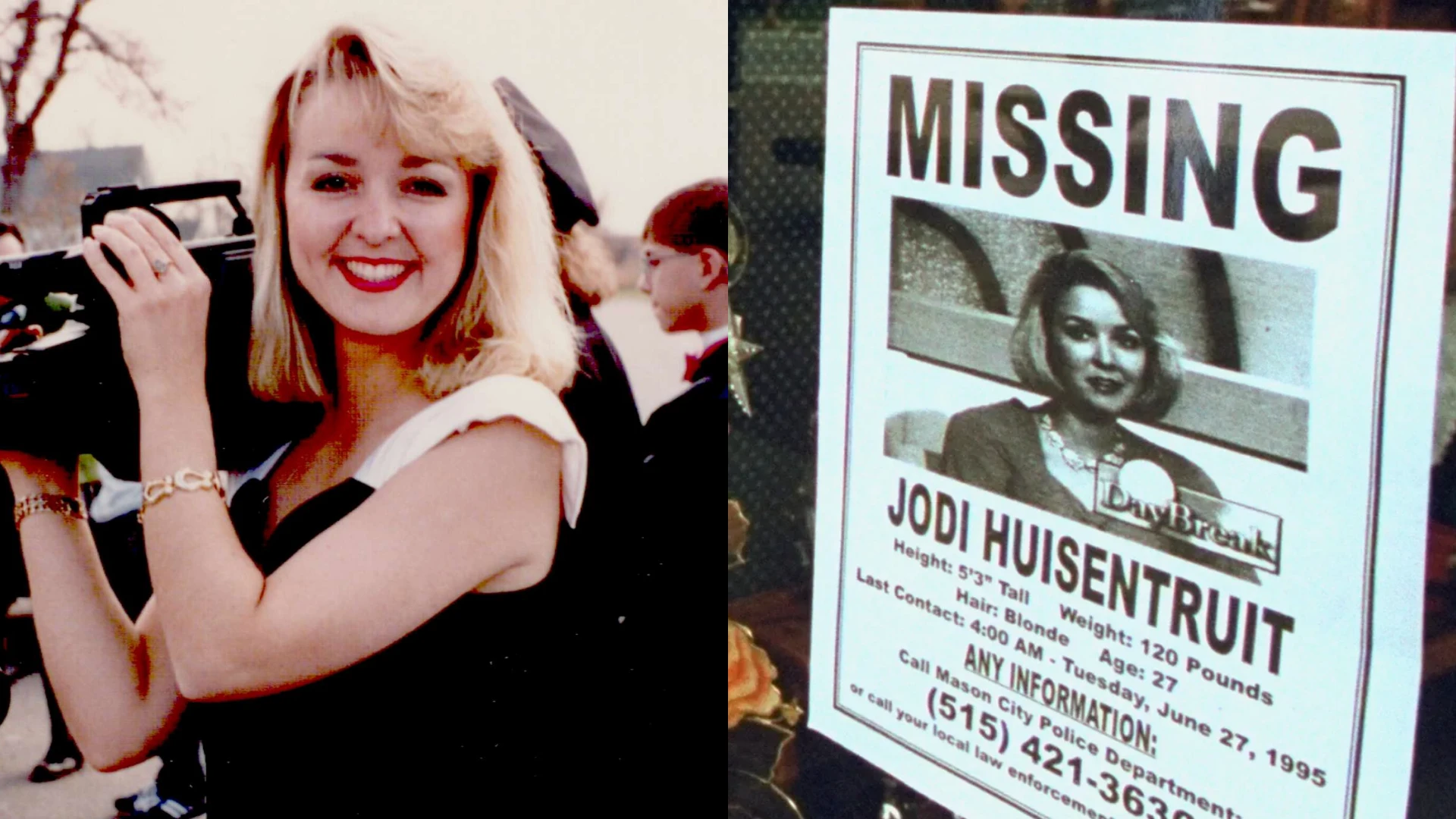
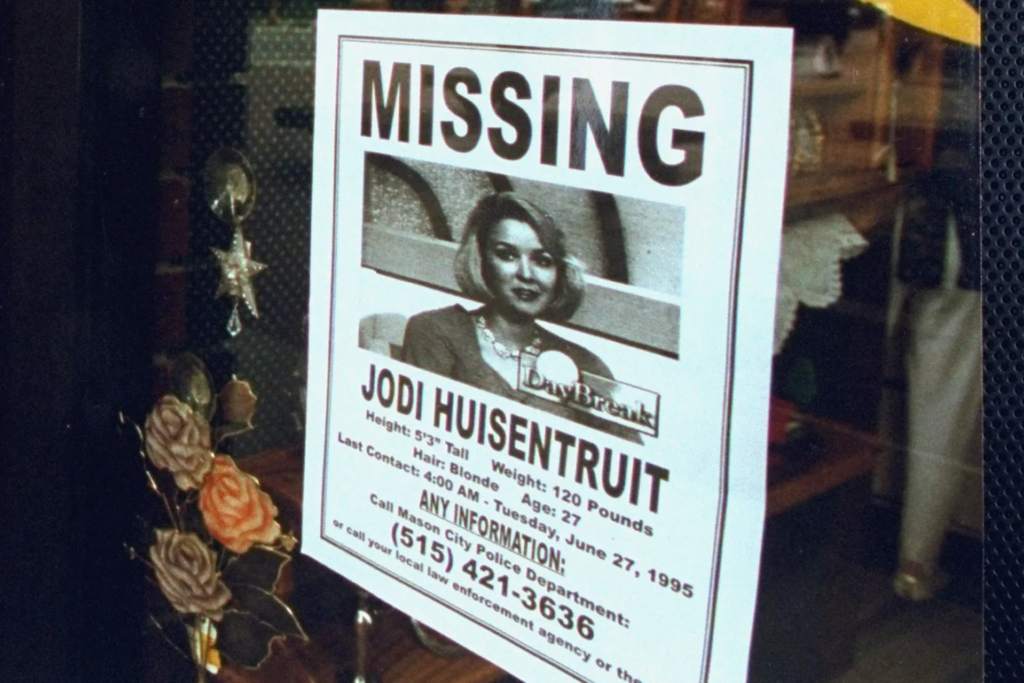
At 4:10 a.m. on June 27, 1995, Jodi Huisentruit answered the phone in her Mason City, Iowa apartment and apologized for oversleeping. She told her producer, Amy Kuns, that she would be at the station soon. The 27-year-old morning anchor for KIMT-TV had never once missed a broadcast in her two years on the air.
By the time the 6 a.m. show went on without her, Kuns had already taken her place at the anchor desk.
“I knew something wasn’t right when I went on the air,” Kuns later said.
Huisentruit never arrived. She has not been seen since.
Huisentruit grew up in Long Prairie, Minnesota, the youngest of three daughters born to Maurice and Imogene Huisentruit. She was a two-time state champion golfer in high school, studied mass communications at St. Cloud State University, and worked briefly as a flight attendant before chasing a career in television news.
By 1995, after stints at CBS affiliate KGAN in Cedar Rapids and ABC affiliate KSAX in Alexandria, Minnesota, she had landed the morning anchor desk at KIMT, fronting the station’s Daybreak broadcast out of a small newsroom in northern Iowa. Colleagues remembered her as driven and well liked, a woman building toward a bigger market.
She would never get the chance.

The Parking Lot Scene
When KIMT staff called the Mason City Police Department for a welfare check at 7:13 a.m., officers found Huisentruit’s red 1991 Mazda Miata, a car she had bought only weeks earlier, still parked outside her apartment at 600 North Kentucky Avenue. Around it lay a bent car key, a pair of red high heels, a hairdryer, earrings, and a can of hairspray, all scattered as though knocked from a bag. Drag marks were visible on the rain-slicked pavement.
Investigators recovered a single unidentified partial palm print from a pole near the car. None of it amounted to a struggle Huisentruit could have walked away from on her own. Investigators concluded she had been grabbed as she reached her car door, with no time to turn her key before it bent in the lock.
At least three neighbors told police they had heard screaming sometime between 4 and 5 a.m. One witness reported a white Ford Econoline van idling in the parking lot at roughly the same time, its lights still on. No one called police that morning. The van was never identified, and no body has ever been found.
A Stalker’s Shadow
Huisentruit’s visibility on local television carried a cost. By the fall of 1994, she had become recognizable enough that she reported to police she was being followed by a black truck while out jogging. The report led nowhere, and Huisentruit never filed another one. Nine months later, she was gone.
Whether the truck and the abduction were connected was never established. No suspect was ever tied to the truck, and the report sat unconfirmed in a case file for nine months until Huisentruit vanished and investigators went back to look at it. What they did establish from the parking lot evidence was that whoever took her knew her routine, her car, and the door she used. Huisentruit was running roughly an hour later than her normal 3 a.m. start time that morning, and whoever was waiting for her still managed to be in position.

The Final Hours
The day before she disappeared, Huisentruit played in a Mason City Chamber of Commerce golf fundraiser, an event cut short by rain. That evening she had dinner at the Mason City Country Club. According to her longtime friend John Vansice, she came to his house afterward to watch a videotape of a surprise birthday party he had helped organize for her earlier that month. Vansice said she left sometime that night and went home.
No one but Vansice can confirm she was at his house at all. What is documented is that Huisentruit called a friend from her own apartment at 8:24 p.m. That single confirmed data point is what makes the rest of the evening hard to pin down: depending on which order the country club dinner, the drive to Vansice’s home, the eighteen-minute video, and the phone call actually happened in, Huisentruit would have had only a few minutes to spare. The exact sequence of that evening has never been resolved, and Vansice’s account is the only version of it that exists.
John Vansice’s Account
Vansice, a retired seed salesman 22 years older than Huisentruit, was one of her closest friends in Mason City. The two often water-skied together, and Vansice had named his boat after her. Days after she vanished, he approached police and identified himself as the last person to see her alive, a claim that placed him at the center of the investigation for decades. His standing in the case deepened because several of Huisentruit’s friends, including Amy Kuns, and her sister, JoAnn Nathe, told investigators they believed Vansice wanted a romantic relationship that Huisentruit had not reciprocated.
“She was like a daughter to me,” Vansice told a reporter within a week of her disappearance.
Vansice cooperated with early interviews and twice took a polygraph test, which he said he passed. In 2017, investigators obtained a search warrant for GPS data from two vehicles registered to him, a sign that he remained a person of interest more than two decades after Huisentruit disappeared. A subsequent grand jury hearing produced no charges, and a judge ruled in 2025 that most of the warrant’s contents would stay sealed. Vansice died in 2024, never cleared and never charged, having maintained until the end that he had nothing to do with her disappearance.
Convicted Felons, No Proof
By the time investigators had interviewed more than a thousand people and chased thousands of tips, including a 1996 ground search of Cerro Gordo County by more than one hundred volunteers, two other men with criminal records had been pulled into the case, neither by hard evidence.
Tony Dejuan Jackson first drew attention simply by proximity and history. He lived a few blocks from the KIMT studio in 1995, had hosted talk shows in college, and had a documented interest in broadcasting, which made investigators wonder whether he had taken note of Huisentruit before he was ever a convicted rapist. That interest hardened into a formal lead only after Jackson was already in prison, when a jailhouse informant named Dennis Goff claimed Jackson had confessed to abducting and killing an anchorwoman, and had recited a rap whose lyrics pointed toward the town of Tiffin, Iowa, roughly two and a half hours away. Cadaver dogs searched a silo near Tiffin in 1998 and found nothing. Jackson’s DNA matched none of the evidence in Huisentruit’s case, and Mason City police formally cleared him in 1999. He has denied any connection ever since, including in a 2025 documentary on the case.
“I had nothing to do with that case,” Jackson said.
A second theory centered on Dustin Honken, a meth kingpin executed in 2020 for murdering five people, including two children, near Mason City in 1993, and his former girlfriend Angela Johnson. The theory held that because Johnson once worked as a server at the Mason City Country Club, and because Huisentruit attended a golf fundraiser dinner there the night before she vanished, the two women may have crossed paths hours before the abduction, and that Honken’s circle could have had a reason to silence a reporter. The theory weakens on its own central point: Johnson told the nonprofit FindJodi by letter in 2019 that she had already quit the country club job months before Huisentruit’s dinner there, and investigators have never found evidence that Huisentruit and Honken ever crossed paths at all.
A third man, Christopher Revak, lived blocks from Huisentruit’s workplace and had an ex-wife who once lived nearby. He died by suicide in an Iowa jail in 2009 while facing a separate murder charge, taking whatever he knew, if anything, with him.

Three Decades of Searching
In 2008, photocopies of 84 pages from Huisentruit’s personal journal arrived anonymously at a Mason City newspaper, postmarked from Waterloo, Iowa. The sender turned out to be Cheryl Ellingson, the wife of a former Mason City police chief who had once led the investigation. Neither faced charges, and the department never explained how copies of evidence from an open case had ended up in a former chief’s home.
In 2022, a television special on the case prompted a new lead. Huisentruit’s childhood best friend, Patty Niemeyer, told investigators that her ex-husband, Brad Millerbernd, had seemed fixated on Huisentruit for years, asking about her often and calling Niemeyer on the tenth anniversary of the disappearance to ask if she knew what day it was. Niemeyer said Millerbernd had taken Huisentruit out once in the fall of 1994 and drove a white Ford Econoline work van, the same make and color reported outside Huisentruit’s apartment the morning she vanished. The timing added weight to the tip: Niemeyer and Millerbernd finalized their divorce on June 23, 1995, only four days before Huisentruit disappeared, and Millerbernd lived roughly three hours from Mason City, close enough to make the drive.
“He needs to be looked at,” Niemeyer said.
Investigators interviewed Millerbernd for ninety minutes, collected his DNA, and administered a polygraph. In 2024, police searched a property in Winsted, Minnesota, where he had once lived. They found nothing connecting him to the case. Millerbernd has never been charged and has denied any involvement.
Huisentruit was declared legally dead in 2001, six years after she disappeared. The Mason City Police Department maintains the case is still active, not cold, three decades on. FindJodi.com, a nonprofit founded by journalists in 2003, continues to gather tips and press for new evidence, and a 2025 Hulu docuseries revisited the case for a new generation of viewers. This past week, on the 31st anniversary of her disappearance, Mason City gathered once more outside the old KIMT building to remember her.
Jodi Huisentruit would be 58 years old now. She never got the bigger market she was working toward, and never got more than a few weeks out of the car she had just bought. What remains of her is a memorial tree planted outside a television station, a granite bench on a Minnesota golf course where she once played, and a porch light that her hometown still turns on every June, waiting for a woman who is never coming home.
