
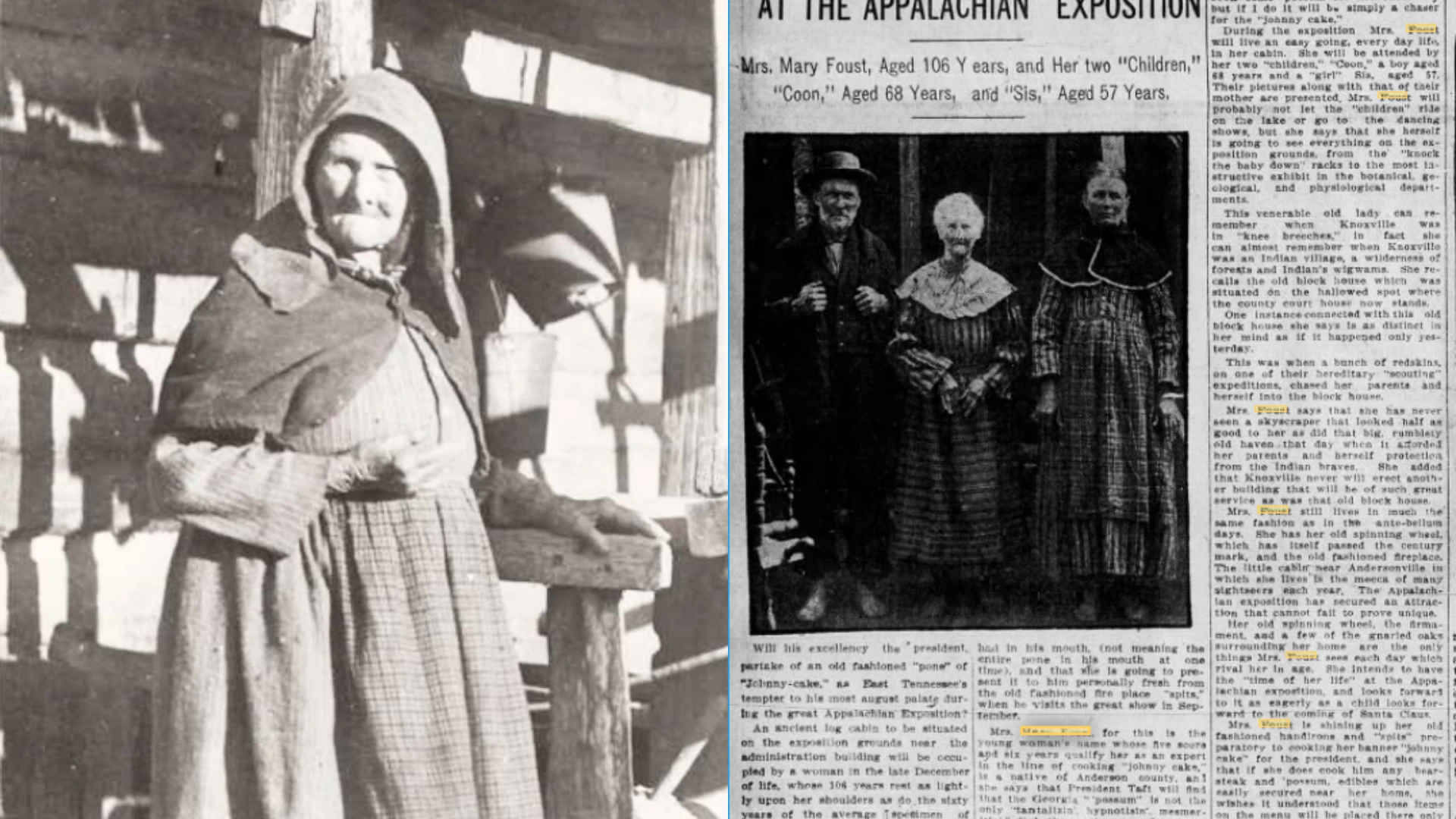
On a cold winter morning in 1847, a uniformed stranger rode up the dirt path into Foust Hollow, Tennessee, and dismounted at the porch of a small log cabin. He carried a letter. Mary Foust, still a young woman, had never received one before in her life. He opened it and read aloud. Her husband John was dead, killed somewhere in the distant theater of the Mexican-American War. The stranger offered his condolences, tipped his hat, and rode off just as quickly as he had come.
Mary stood alone on the rough-hewn porch of the same log cabin her grandfather had built nearly a century earlier. Two small children were inside. Two hundred acres of creek bottomland and steep wooded slopes spread out in every direction, hemmed in by the thick canopy of Lone Mountain. The nearest neighbor lived miles away.
She did not leave. She would not leave. Not for another 68 years.
Deep in Cherokee Country
Mary Ann Elizabeth Foust was born around 1812 in Anderson County, East Tennessee, the daughter of Daniel Nathaniel Foust and Nancy Elizabeth Epperson. Her family were among the earliest white settlers to work the narrow ribbon of valley that would eventually bear their name for generations. The Fousts had come from Germany sometime in the previous century, and the family name itself meant, literally, fist. Mary’s great-great-grandfather had carried a handmade loom across the Atlantic when he crossed; it would still be in daily use in Foust Hollow more than a century later.
The land they had claimed was fertile bottomland threaded by cold creek water and walled on both sides by ridgelines so densely forested that even midday sunlight struggled to reach the forest floor below. At the time of Mary’s childhood, this corner of East Tennessee still pressed against the edge of Cherokee territory.
When she was approximately 12 years old, her parents made the six-day walk to Knoxville, following animal trails over ridges and down through mountain coves, sleeping each night under rock overhangs or beside small fires that did little against the cold. The journey left Mary’s bare feet toughened as leather.
Knoxville at that time was half fort and half town, its blockhouse still a refuge against the threat of conflict with Native peoples. When the Foust family finally dropped down out of the last mountain gap and saw the settlement sprawled along the banks of the Tennessee River, Mary stopped dead in her tracks. “Look at all those people,” she reportedly gasped.
“There must be more than 200 souls.” It was more than the mountain girl had ever seen in her life. Dirt streets rutted by wagon wheels, log buildings crowded shoulder to shoulder. Her father had business with a local trader. But no sooner than the family arrived, whispers of an Indian uprising circulated through the settlement, and for three terrifying nights they sheltered inside the blockhouse with dozens of other frightened settlers.
Mary never forgot it. For the rest of her life, she never willingly left the holler again.
The War Takes Everything
Mary married John Sartin and settled into the log cabin at Foust Hollow, building a life around the self-sufficient pioneer practices her parents had modeled. When the Mexican-American War broke out in 1846, the U.S. Secretary of War requested 2,800 volunteers from Tennessee. More than 30,000 men answered the call, among them John Sartin.
On June 1, 1846, Mary accompanied her husband to Knoxville, where he was mustered into the First Tennessee Volunteer Infantry. She watched him load onto a steamship on the Tennessee River. The current carried him south into unknown waters.
She would never see him again.
Seven months later, the uniformed stranger arrived with the letter.
Seventy Years Alone
What followed was not grief made visible, or at least not that anyone ever recorded. Mary rose before dawn each day and worked until the last light left the sky. She split fence rails with an axe, tanned hides for plow harnesses, tended beans in the bottomland and corn on the hillsides. She had no stove and prepared every meal over the mud-and-brick fireplace that had served the cabin for generations. She hunted for meat, set her own rabbit and fish traps, and was by all accounts a crack shot with a long rifle.
Each evening, she sat on the front porch and studied the night sky. She predicted incoming weather by tracking the phases of the moon and forecast spring floods by the presence of rings around it. When the garden overflowed, she preserved beans on strings to dry and kept the smokehouse full of hams and salted pork.
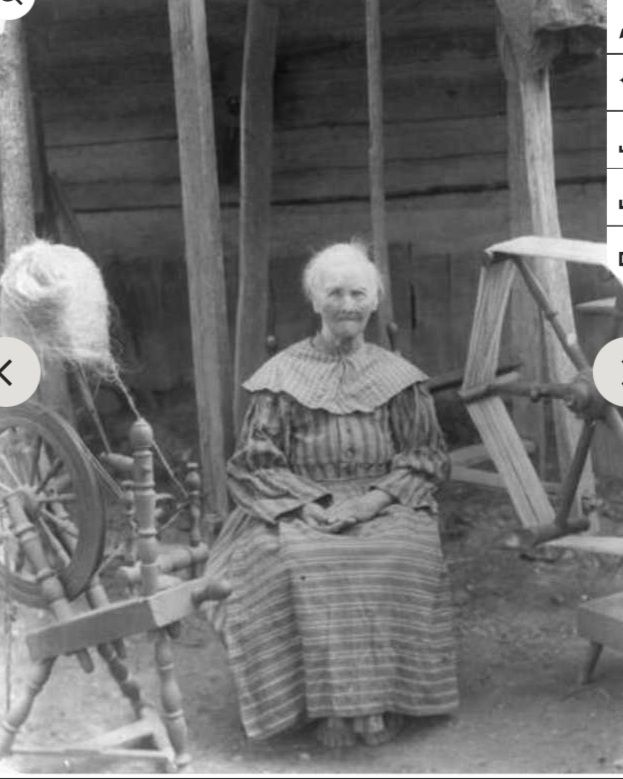
She carded and spun wool on the same loom her great-great-grandfather had carried from Germany and sewed every piece of clothing her family wore. Most nights, her son Christopher, known as Coon, sat beside her and helped work the wool. Her daughter Mary, known as Sis, grew into a skilled marksman rarely seen without a rifle slung over her shoulder while tracking bear through the forest. Mary swore that none of the three of them had been sick a single day in their lives.
But Mary’s most singular creation was her communication system. She owned a cedar-and-iron signal horn, approximately four feet long, which had been passed down through the Foust family for generations and was estimated, by the time of her old age, to be nearly 200 years old. The iron bands that held its two pieces of cedar together had been hand-forged by a blacksmith, a level of craft that placed the horn’s origins well back into the previous century.
It was one of her most valued possessions. Standing at the summit of Lone Mountain, Mary had worked out an entire code of long and short blasts to call in the hunting dogs, the cows, and her children, and to warn neighbors during emergencies. In a landscape where the nearest family might live two miles across broken terrain, the horn served the same function as a telegraph line.
The decades rolled past in the world beyond Foust Ridge. The Civil War came and went. The removal of the Cherokee was completed. Mary remarried in 1883, but her second husband died within months of the wedding. By 1900, the outside world had telephones, electric light, and automobiles. Mary’s cabin had none of them. Within twenty miles of Knoxville, she and her children clothed and fed themselves entirely through their own labor, the same way the Foust family had always done. It did not need to change because Mary did not want it to change. So it did not.
The World Discovers Her
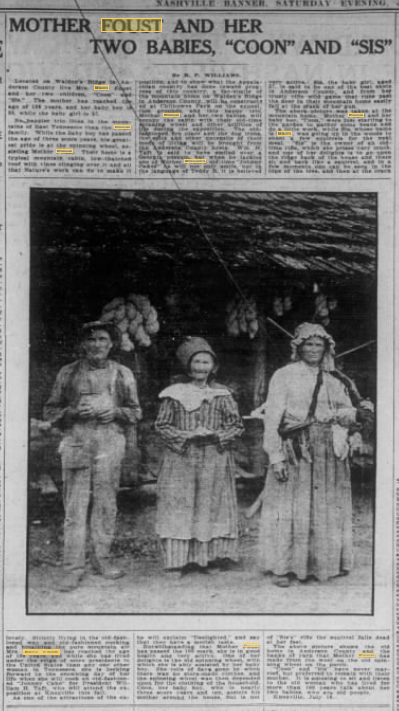
By 1910, historians and curiosity seekers had begun making the pilgrimage to Foust Hollow. Mary was somewhere north of 95 years old and was by then considered by many to be the oldest living American, still working from sunup to sundown alongside Christopher and Sis, who were by then in their fifties.
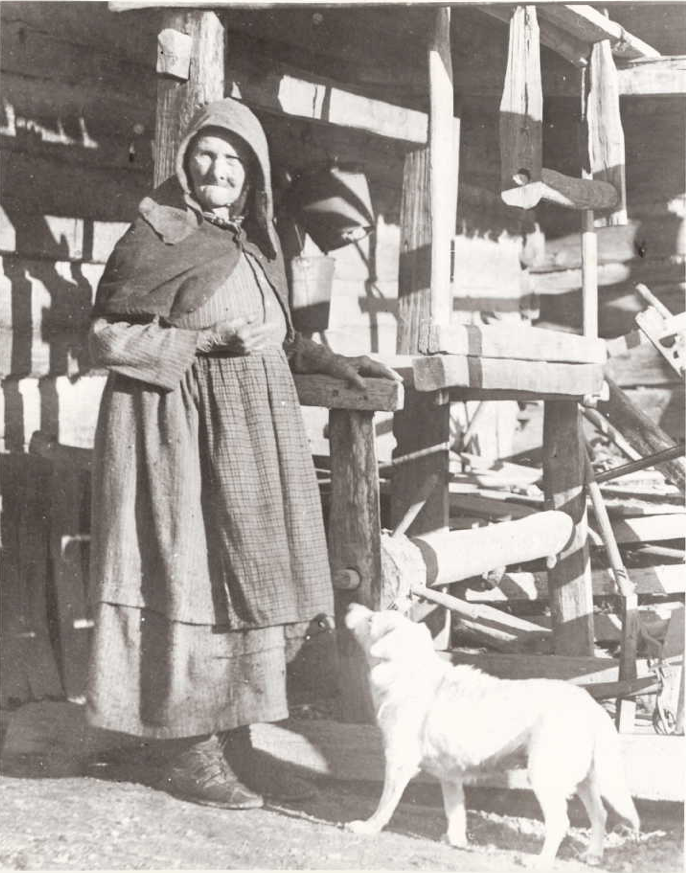
She still called them her babies. Visitors were greeted at the door by her dog Pen. Mary, seated at her spinning loom, told the story of her life to anyone who asked. Photographers came. Newspapers came. Postcards of Mary and Sis sold by the tens of thousands to strangers who marveled at a woman still living exactly as her great-grandparents had.
The Great Appalachian Exposition of 1910 brought half a million visitors to Knoxville between September 12 and October 12 of that year. A replica of Mary’s log cabin was constructed at the Chilhowee Park fairgrounds, where she and her children cooked traditional Appalachian meals over an open fireplace, demonstrated weaving on the family loom, and told stories to thousands of strangers who had never seen anything like them.
Mary walked to Knoxville for this third and final visit, as she had for the first two, on foot. Former President Theodore Roosevelt attended the 1910 exposition, and President William Howard Taft attended the following year’s event. Between the two expositions, Mary reportedly cooked johnnycakes for both men over her open fire.
She had now been to Knoxville three times in her life. Once as a terrified 12-year-old sheltering from the threat of an Indian raid alongside her parents. Once to watch her husband steam away to a war he would not survive. And now, at nearly 100 years old, as the living embodiment of a world that had otherwise ceased to exist.
What Remained
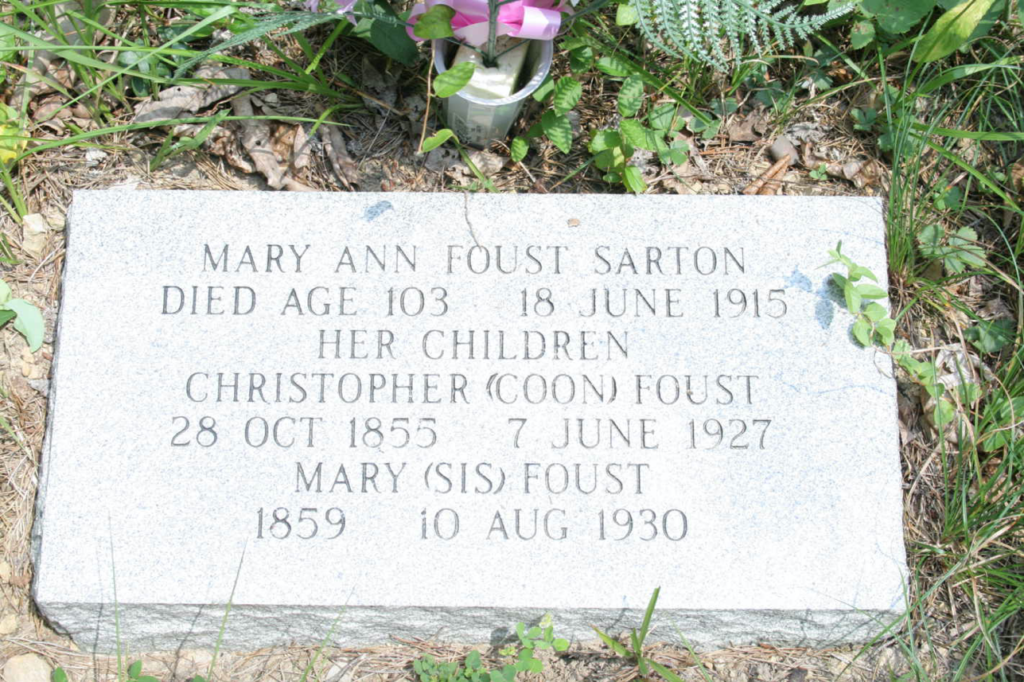
Mary Ann Elizabeth Foust Sartin died on June 18, 1915. She was 103 years old. There was no obituary. The woman who had been celebrated by half a million people at the Appalachian Exposition just five years earlier was simply never mentioned again.
Her signal horn passed through the hands of a family member, then an antique collector, before eventually finding its way to the Museum of Appalachia in Norris, Tennessee, a few miles from the hollow where she had been born, worked, and died. Her loom made the same journey. Both now sit in the museum’s Appalachian Hall of Fame. The horn is a four-foot cedar-and-iron instrument, its hand-forged bands still holding after more than two centuries. The hollow bears the family name. The cemetery is in the woods behind where the cabin once stood.
On the stone: MARY ANN FOUST SARTON. DIED AGE 103. JUNE 18, 1915.
