
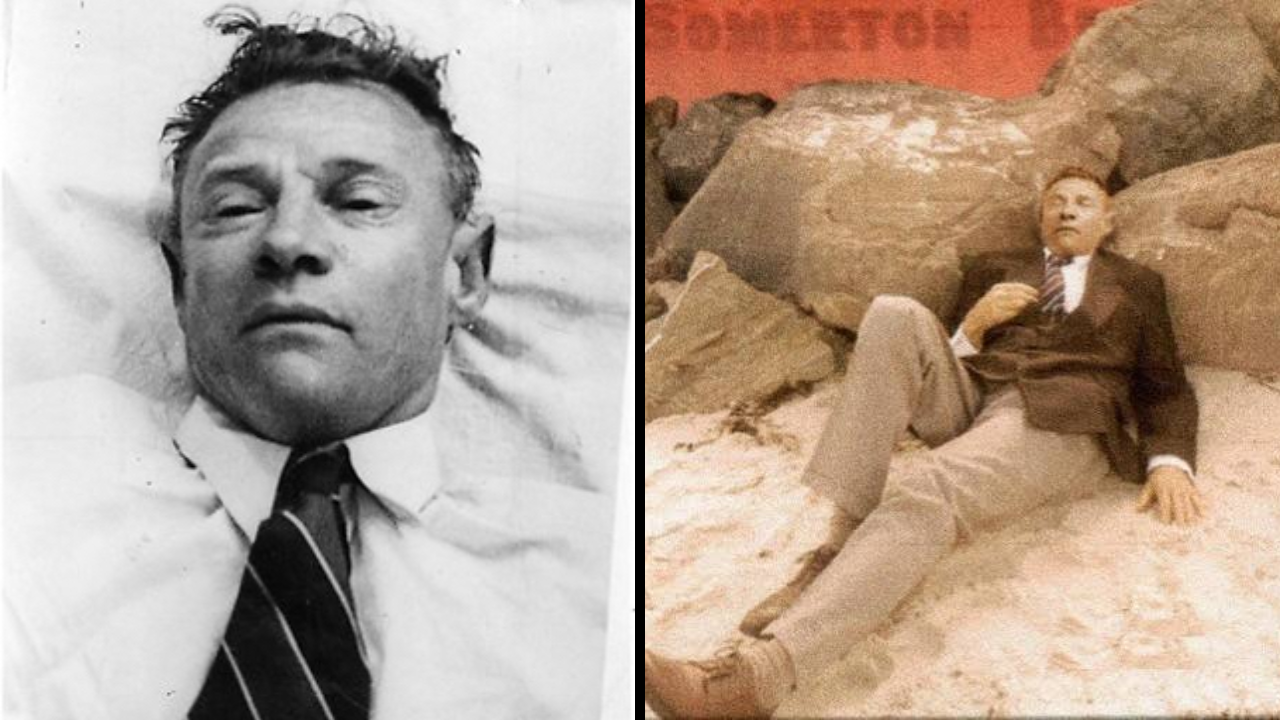
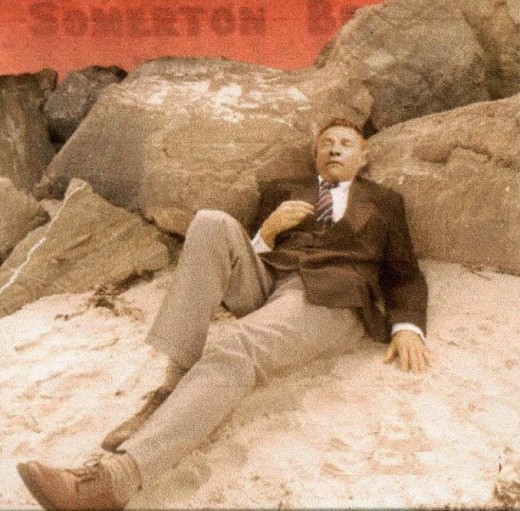
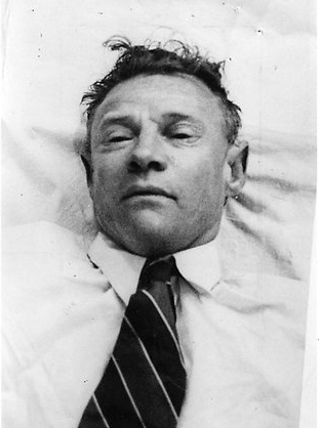
On the morning of December 1, 1948, two jockeys exercising their horses along Somerton Park Beach, seven miles south of Adelaide, came across a man lying against the seawall. He was well-dressed. His legs were crossed. An unlit cigarette had fallen from his mouth onto the lapel of his jacket. When they rode over to check on him, he did not move. He was dead.
Police arrived to find no wallet, no identification, and no explanation. His shoes were recently polished. His clothes were dry. He had not been struck or strangled. His body was in excellent condition. He appeared to be in his early forties and had simply stopped living.
For the next 74 years, he would be known only as the Somerton Man.
The body on the beach
The night before, at around 7:00 p.m. on November 30, a local jeweler named John Lyons and his wife had spotted the man in the same spot, propped against the seawall with his legs crossed. They noticed him raise one arm and let it fall. Assuming he was drunk and sleeping it off, they kept walking. Around 8:00 p.m., a second couple saw a man standing at the top of a nearby staircase, looking down at the figure on the beach. That man was never identified.
When police inventoried the body, they found an unused railway ticket to Adelaide and a used bus ticket. He carried two combs, one plastic and one aluminum, the latter rarely available in Australia at the time and believed to have been made in the United States. There was Juicy Fruit gum, also more commonly associated with America, a box of matches, and a pack of Army Club cigarettes containing a different, more expensive brand of cigarettes inside. The lining of one trouser pocket had been repaired with an unusual orange waxed thread.
He carried no wallet. There was no identification. Every label had been cut from every item of clothing he was wearing.
The postmortem established that the man was between 40 and 45 years old, five feet eleven inches tall, gray-eyed, and clean-shaven, with ginger-brown hair graying at the temples. He was heavily built, with unusually developed calf muscles. His hands showed no signs of manual labor. His toes had been pressed into a wedge shape consistent with a lifetime of wearing pointed, high-heeled shoes. He was missing his lateral incisors, the teeth flanking the two front teeth, with his canines having shifted forward into the gaps. His hands were yellow-stained from heavy smoking.
The internal findings were more troubling. His liver showed an excess of congealed blood. His spleen was three times its normal size, consistent with a long-standing pre-existing condition. No cause of death could be immediately determined. His heart, otherwise, was in perfect condition.
Police believed someone would come forward to identify him within days. Nobody did.
The suitcase
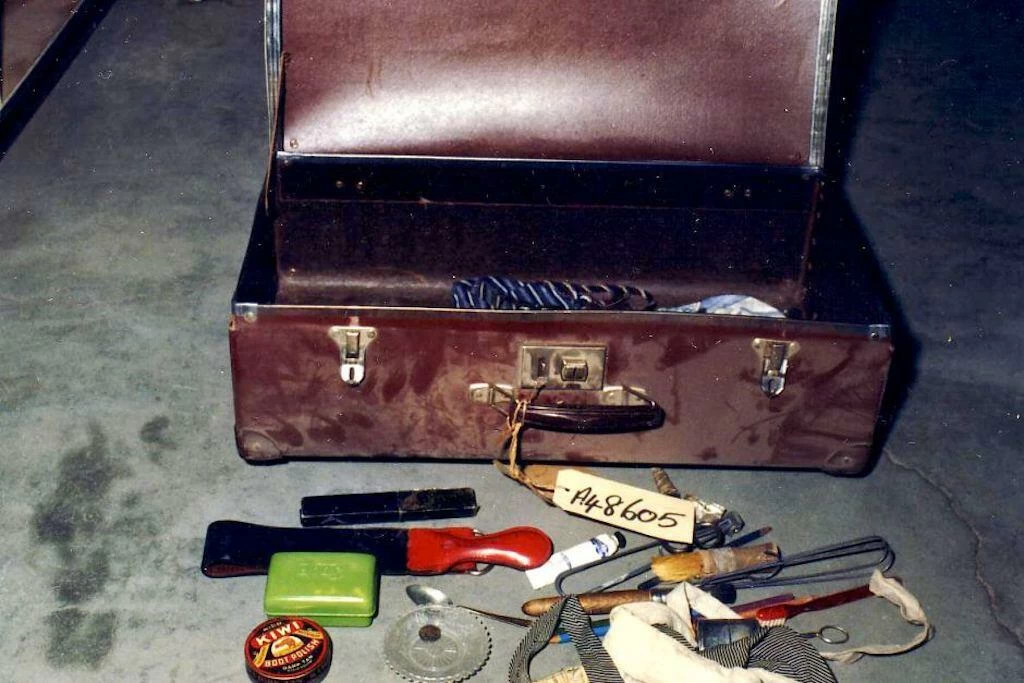
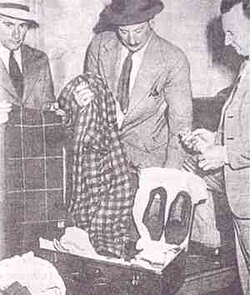
In January 1949, detectives searching Adelaide Railway Station for unclaimed luggage found a brown suitcase deposited in a locker on November 30, 1948, the day before the Somerton Man was found dead on the beach. No railway employee could remember the man who left it.
Inside were toiletries, a laundry bag, clothing, pajamas, slippers, and a dressing gown. There was also a stenciling brush of the type used on cargo ships, an electrician’s screwdriver, a table knife that had been sharpened into a potential weapon, scissors with sharpened points, and a small piece of zinc. A pair of trousers held sand in the cuffs. Every label in the suitcase, like the labels on the dead man’s clothes, had been removed.
Three items were exceptions. A laundry bag, a tie, and a singlet were each marked with a variant of the name “Keane.” Police conducted a nationwide search for any missing or unaccounted person by that name and found nothing. The working theory became that the items were secondhand, purchased during the wartime clothing shortage, and that whoever Keane was, he was likely unconnected to their victim. The possibility that the labels had been left deliberately to mislead investigators was also noted.
One thing in the suitcase settled the question of ownership. Orange waxed thread, identical to the unusual thread used to repair the dead man’s trouser lining, was found inside the case. The suitcase was his.
Tamam Shud
The case went nowhere for months. Then, in June 1949, a pathologist re-examining the man’s clothing found something that had been missed. Buried in a small fob pocket, wound tightly and pushed deep into the lining, was a tiny scrap of paper. The pathologist extracted it with a scalpel. Unrolled, it bore two words in Persian: Tamam Shud, meaning it is finished, or it is ended.
Police traced the phrase to the final line of the Rubaiyat of Omar Khayyam, a beloved Victorian-era poetry collection whose themes center on seizing the day, accepting mortality, and dying without regret. They issued a public appeal for anyone with a copy that had a page torn out. On July 22, 1949, a man came forward anonymously. He said he had found the book on the rear seat of his unlocked car, parked near Somerton Beach at the end of November. A paper expert confirmed the torn page and the scrap were a perfect match.
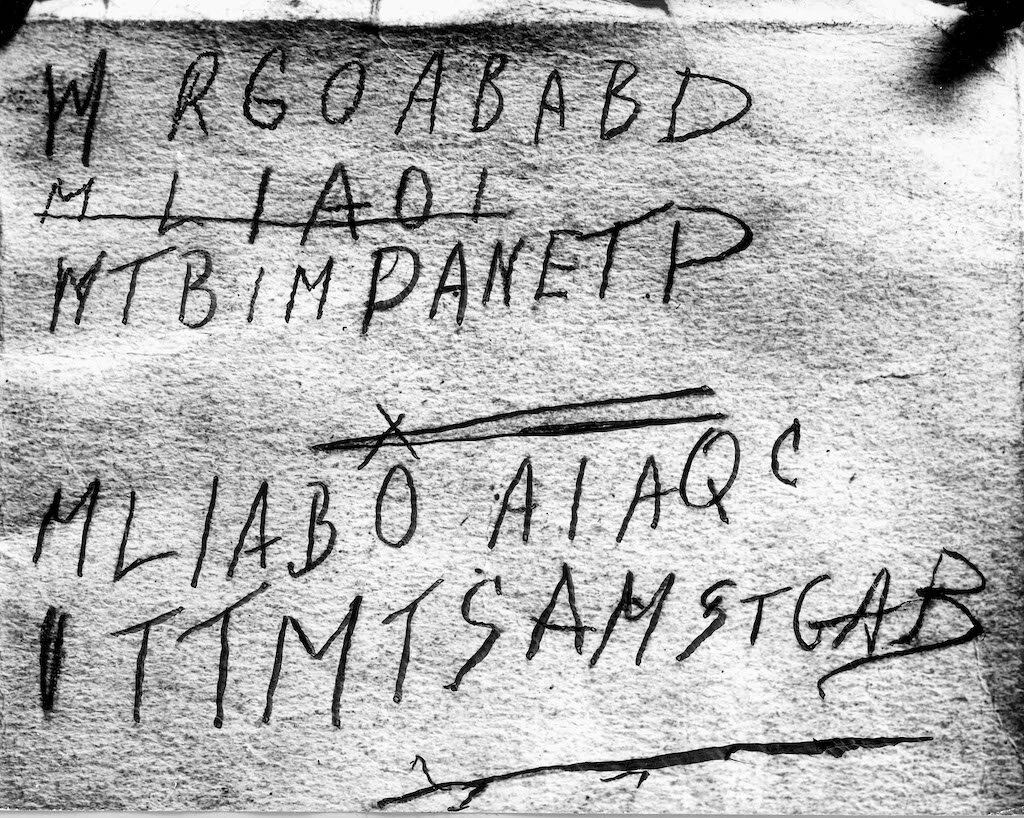
In the back of that book, someone had handwritten four lines of capital letters. One line had been crossed out and rewritten at the bottom. The sequence bore no resemblance to any known language. Police brought in expert code breakers. They published the letters in newspapers, inviting attempts from the public. Military cryptanalysts were consulted over the following decades. The code has never been broken.
The book also contained two phone numbers. One belonged to a bank. The other belonged to a woman.
Jo Thomson
The woman with the phone number in the Rubaiyat lived a few hundred yards from where the Somerton Man’s body had been found on the beach.
On July 26, 1949, nearly eight months after the discovery, police arrived at her door. She was a nurse. Her real name was Jo Thomson, though for years she appeared in police files only under her nickname, “Jestyn,” the name she had signed in a copy of the Rubaiyat she had given to a man named Alf Boxall in 1945, when she was working as a nurse in Sydney. Boxall had been a lieutenant in the Australian Army. Police initially believed he might be the Somerton Man. He was not. When they tracked him down, he was alive and still had the book Jo Thomson had given him, inscription and all.
Jo Thomson denied knowing the dead man. She said she did not recognize the police’s plaster cast of his face. But detectives noted her behavior during the interview as unusual. She looked at the floor repeatedly. She answered in short, clipped phrases. One officer later recorded that when she saw the cast, she appeared to nearly faint.
She said nothing further. She subsequently married Prosper Thomson, had a daughter named Kate, and raised a son named Robin. Robin, when he grew up, became a ballet dancer. The Somerton Man’s unusually developed calves had earlier led investigators to suggest he, too, may have had a background in dance.
Jo Thomson never spoke publicly about the case. When coverage resurfaced in the press over the years, she reportedly left Adelaide on holiday until the attention passed. She died in 2007.
In a 2013 interview for 60 Minutes, Kate said her mother had known who the Somerton Man was and had refused to say. Kate also revealed that she had discovered her mother spoke Russian, though Jo Thomson had never explained when or how she had learned the language. Kate’s own conclusion was that her mother had been a Soviet spy.
The Cold War theory
The spy theory was not fringe.
The Somerton Man was found at the start of the Cold War, at a time when Australian counterintelligence was actively tracking Soviet agents. Approximately 300 miles northwest of Adelaide sat the Woomera Rocket Range, then the second-busiest rocket testing facility in the world outside Cape Canaveral, and the headquarters of a joint Anglo-Australian program developing V2 rocket technology. The region was a significant target for Soviet intelligence.
The dead man’s clothing bore American markers. His cigarettes had been swapped between packs. Every identifying label had been removed. He appeared to carry an unbroken code. The woman whose phone number appeared in his copy of the Rubaiyat lived near his body, spoke Russian, and refused to cooperate with police for the rest of her life. The man who handed over the Rubaiyat remained anonymous and claimed it had simply appeared in the back of his unlocked car.
There was also Alf Boxall, whom some researchers believed had connections to military intelligence.
For seven decades, the spy theory accumulated circumstantial weight without ever gaining a verified foundation. Then, in 2022, a different kind of investigation produced a name.
Carl Webb
Professor Derek Abbott of the University of Adelaide had been working the Somerton Man case since the 1990s. He extracted hair follicles from the plaster cast made of the man’s head and, working alongside forensic genealogist Dr. Colleen Fitzpatrick, ran them against a genealogical database containing millions of profiles.
A match emerged on the maternal side: a first cousin three times removed. Working outward from that connection, Abbott and Fitzpatrick built a family tree of 4,000 names and triangulated it down to a single individual.
Carl Charles Webb. Born November 16, 1905, in Footscray, a suburb of Melbourne. His father, Richard August Webb, had been born in Hamburg, Germany, and worked as a professional baker. Carl was the youngest of six siblings. Death records exist for all of them. For Carl alone, no death certificate has ever been found.
Webb trained as an electrical engineer and instrument maker. On October 4, 1941, he married Dorothy Jean Robertson. Their marriage certificate listed him as 35 years old. Court records from October 1951, nearly three years after his body was found on Somerton Beach, show Dorothy applied for a divorce on the grounds of desertion. The notice was published in The Age newspaper in Melbourne and addressed to a husband who could not respond because he had been buried in Adelaide’s West Terrace Cemetery since 1949.
Researchers examining the divorce documents found a man in steady decline. In a seven-year stretch during their marriage, Carl Webb lost his father in 1939, a brother in the war, a nephew who died in service in Europe, and his mother in 1946. Dorothy described her husband as sullen and withdrawn when he lost at cards, reclusive, sometimes going days without speaking to her. In January 1946, she came home to find him in bed, soaking wet, staring blankly. The house smelled of ether. He told her he had swallowed 50 tablets. The couple separated in 1947. Dorothy was granted a divorce in 1952.
Amateur researchers and Abbott’s team also traced the mystery of the “Keane” labels. Carl’s brother-in-law was Thomas Gerald Keane, and his nephew John Keane had died in service in Europe. His belongings had been sent home to the family. The clothing in Carl Webb’s suitcase, it appears, was simply hand-me-downs from relatives who no longer needed them.
A photograph from a Swinburne University football team in 1921 is believed to show Carl Webb, listed as “C. Webb.” Researchers noted that football training would explain his unusually developed calf muscles. His wedge-shaped toes were consistent with a lifetime in pointed, high-heeled shoes. His passion for betting on horses, documented in the divorce papers, offered one explanation for the uncracked code in the Rubaiyat. Bettors of that era sometimes kept horse names in private shorthand. Carl was also known to have enjoyed writing poetry. The crossed-out and rewritten line in the back of the book may have been a verse in progress.
In 2021, South Australian authorities exhumed the Somerton Man’s remains. Abbott and Fitzpatrick announced their identification of Carl Charles Webb in the summer of 2022, stating 99.9 percent confidence in the result. As of the latest available reporting, South Australian Police had not issued an official confirmation.
Carl Webb’s headstone in West Terrace Cemetery still reads: Here lies the unknown man who was found at Somerton Beach, 1st December 1948.
The inscription has not been changed.
