
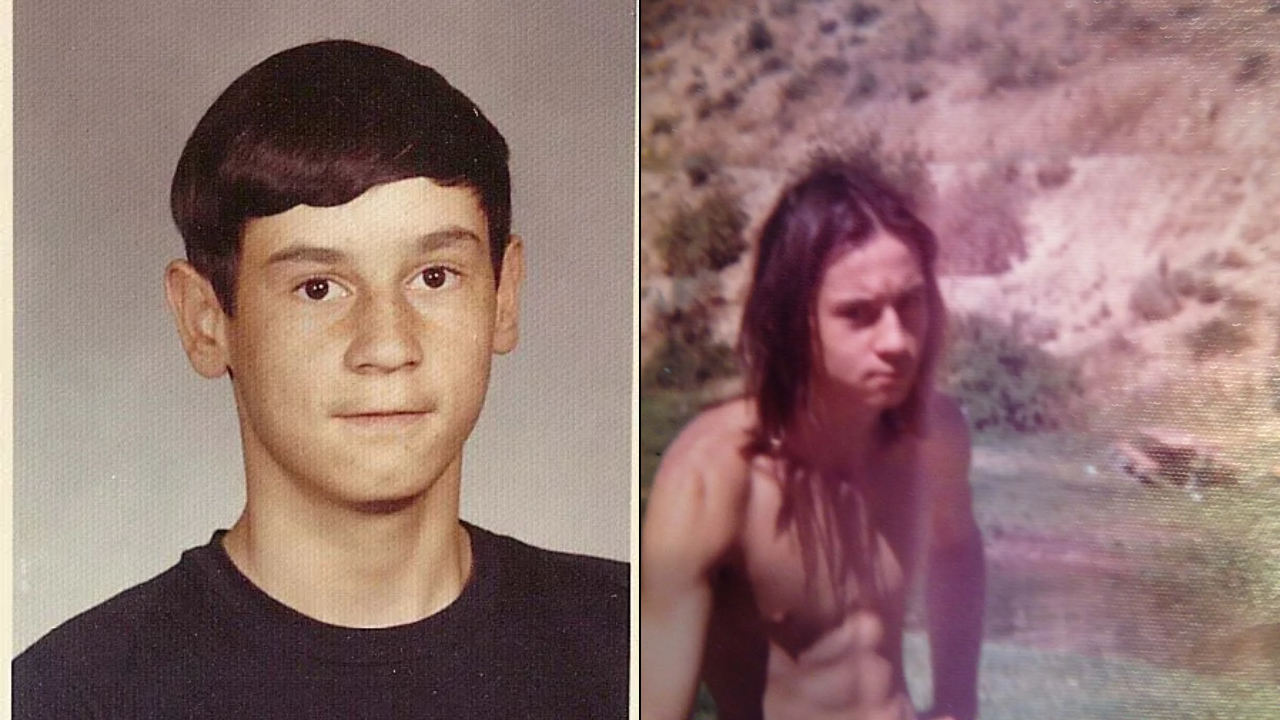
A seventeen-year-old busboy from Boise drove to Huckleberry Flats on a Sunday afternoon in October 1974. He told his sister he was going with someone. He never said who. Two days later, searchers found him face down in a creek, shot once through the stomach, in the snow.
He Never Said Who He Was Meeting
Around 1 a.m. on Sunday 20 October 1974, Mark Stefan Carlson walked through the living room of the family home on Shoshone Street in Boise, Idaho, and asked his sister Connie and her friends to keep the noise down. He was trying to sleep. He had to be up early. He was going hunting for the first time.
Connie Sheldon, only ten months older than her brother, asked him where he was going. He held up a map, heavily marked up, and pointed to an area north of Boise called Huckleberry Flats — a stretch of open land along Harris Creek Road, between Horseshoe Bend and Placerville, roughly three miles southwest of Placerville. None of them had heard of it. Connie told him he shouldn’t go alone.
He said he wasn’t going alone. She asked who he was going with.
“Someone,” he said. He went to bed without saying more.
Connie later told NBC’s Dateline that she was not entirely sure whether to believe him. He may have been going alone and simply saying otherwise to avoid an argument. She told him: if nobody goes with you, wake me. I’ll come. I’ll sleep in the car He didn’t wake her.
A Good Kid With No Enemies
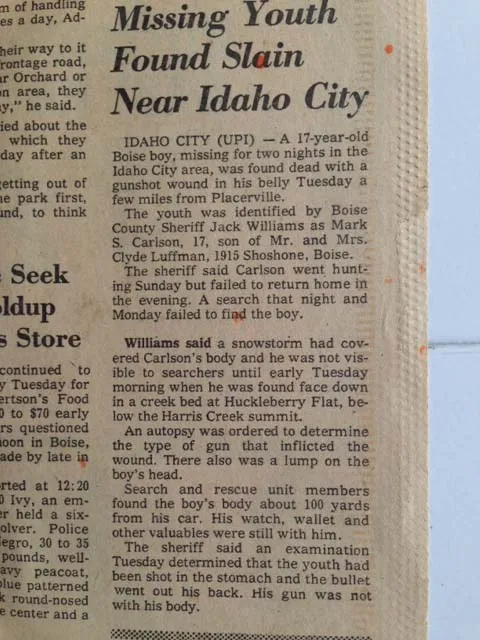
Mark Stefan Carlson was born on 19 September 1957, the fifth of nine children. He grew up in Boise, living at home with his mother, stepfather Clyde Luffman, and his siblings. He had just turned seventeen — barely a month before his death. By every account available, he was a straightforward, responsible teenager who stayed close to home and had no history of conflict with anyone.
He did not drink. He did not smoke. He had been a Boy Scout and coached Little League baseball in his spare time. His sister described him as sweet and shy, particularly around girls — she later recalled that he had never had a girlfriend. He had recently taken his first job as a busboy at the Downtowner Motel in Boise, recently taken out a loan on his first car — a blue Mustang — and had, by all indications, just begun to find his footing in the world.
His stepfather Clyde Luffman, in a recorded 1977 meeting with investigators, summed up what the entire family had been trying to understand since the night Mark didn’t come home: “He didn’t drink. He didn’t smoke. He liked to stay at home. And why anybody would shoot him, I’ll never know.”
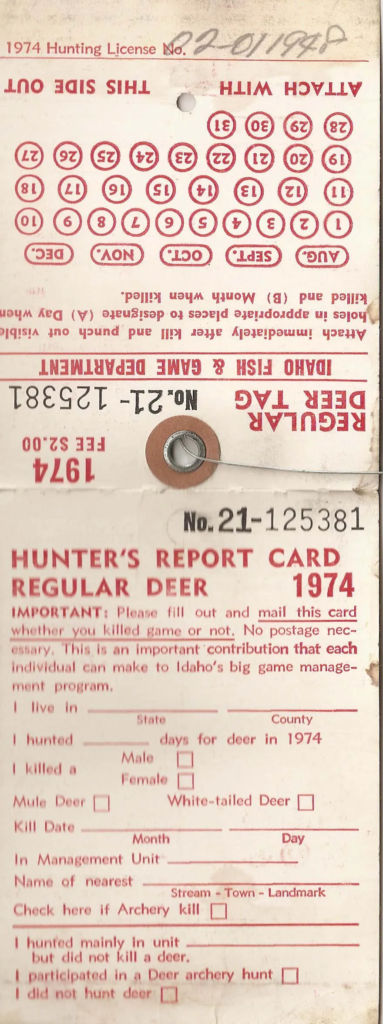
On the morning of 20 October, Mark bought a deer hunting licence, loaded his 30-30 bolt-action Sears rifle, put on his new red hunting vest, and drove north toward Huckleberry Flats.The rifle and vest would both be gone by the time his body was found.
Snow Buried the Evidence Overnight
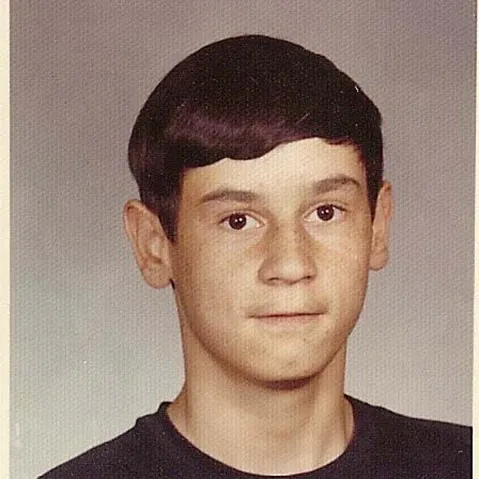
Mark did not come home that night. By 9.30 or 10 p.m., the family was sitting on the couch, waiting. His mother and stepfather contacted police. Idaho State Police, search and rescue teams, and officers from the Fish and Game Department began searching the Huckleberry Flats area.
A snowstorm moved in as darkness fell and continued through the following morning, significantly slowing the search.
The Carlson family learned he had been found not from a phone call, but from the television. The set was on with the sound turned off. A news report appeared on screen. Someone called the house about an hour later to confirm it.
On 22 October 1974, two days after Mark had left home, searchers found his body face down in a creek, covered in snow, approximately one hundred yards from where his blue Mustang was parked. He had been shot once through the left side of his stomach with a single high-powered rifle round.
The bullet had exited through his back and was never recovered. He also had blunt trauma to the back of his head, suggesting he had been struck by an object before or after the shooting. One side of his body was caked in mud.
The mud on one side of his body, combined with the heavy abrasions on his back, led investigators to conclude that Mark had not been shot where he was found.
He had been killed somewhere else on the flats and dragged through the dirt to the creek. The medical examiner determined the cause of death was excessive blood loss. Investigators believed he had likely survived for no more than half an hour after being shot — bled out in the open, in the snow, in the dark.
Three work paychecks were still on his body. His car was untouched. Police ruled out robbery as a motive. Whatever had happened on Huckleberry Flats, it was not a mugging.
A couple living on the ridge above the creek told investigators they had seen Mark twice that afternoon: once wearing his hunting vest, and once carrying it. The two separate sightings suggested he had been moving around the flat for some time. They reported nothing unusual.
The Rifle Reappeared. The Vest Did Not.
Investigators initially had almost nothing to work from. The scene had been covered by snow. The bullet had not been recovered. No witnesses had come forward with a direct account of what happened.
A store clerk reportedly told police he had seen someone with Mark on the day of the trip, which would have indicated Mark was not alone on the flats. Investigators were cautious: the clerk was uncertain about the dates, and with the events already receding into the past, that uncertainty was difficult to resolve. The testimony was never confirmed.
Witnesses also reported seeing a Volkswagen Beetle driving erratically along Harris Creek Road close to where Mark’s body had been found. The vehicle and its driver were never identified, and whether they had any connection to his death — or were simply a passerby — remains unknown.
Two years after the murder, Mark’s 30-30 Sears rifle was found approximately a mile from where his body had been recovered. The discovery removed any remaining doubt about suicide: a man who shoots himself does not walk a mile and dispose of his own weapon. Idaho State Police formally concluded that Mark had been killed by another person. The case was registered as a homicide.
The significance of the missing items — the rifle removed and discarded a mile away, the red hunting vest never found at all — points toward deliberate concealment. Someone took those items from the scene. Someone chose to remove them rather than leave them. The vest has never surfaced in fifty years of searching.
Two Theories, No Arrests, No Confession
Idaho State Police have worked under two primary theories since the case opened. The first is deliberate murder: someone on Huckleberry Flats that day killed Mark intentionally, for a motive that has never been established.
The second is a hunting accident that became a cover-up: a shooter mistook movement in the brush for a deer, fired, realized they had shot a person, and chose to flee rather than summon help. Under this second theory, the blow to the head, the removal of the rifle and vest, and the dragging of the body all represent attempts to obscure what had happened.
Both theories have significant problems. A panicked hunter who accidentally shoots someone does not typically stop to drag the body to a new location, strike the victim over the head, and strip them of their vest. Deliberate murder requires a motive, and no motive has ever been identified — Mark Carlson had no enemies, no debts, no entanglements. The evidence points toward something calculated. The person it points toward remains unidentified.
The Carlson family’s own belief is more specific: they think Mark met someone he knew on the flats that day. Possibly a co-worker from the Downtowner. The unnamed “someone” he mentioned to Connie the night before he left.
They believe that person, whoever they were, is still alive.Without physical evidence or a witness willing to come forward, however, there is nothing to charge anyone with.
The case was eventually closed, then reopened at the Carlson family’s request thirty-nine years after the fact. Idaho State Police Captain Bill Gardiner confirmed at the time of reopening that investigators had received enough new information to follow up on certain leads. He did not specify what those leads were.
The original investigators from 1974 are all dead.
The family has hired multiple private investigators over the decades. None has produced a result. In 2020, Crime Stoppers of Southwest Idaho offered a reward of up to one thousand dollars for information leading to an arrest. The Carlson family added a further ten thousand dollars for information leading to an arrest and conviction.
“It’s going to take a confession, I believe,” Connie Sheldon told reporters. “It may take someone who knows information about that to actually show the bravery to step up.”
Someone on Those Flats Knows What Happened
Mark Carlson had just turned seventeen. He had just started his first job. He had just taken out a loan on his first car. He was too shy, his family said, to have had a girlfriend yet. He had barely begun his adult life before it was taken from him on a snowy afternoon in Boise County.
What remains fifty years later is a marked-up map, a missing red vest, and a question no one has yet answered: who was the “someone” Mark said he was meeting, and what happened between the two sightings on that ridge.
