
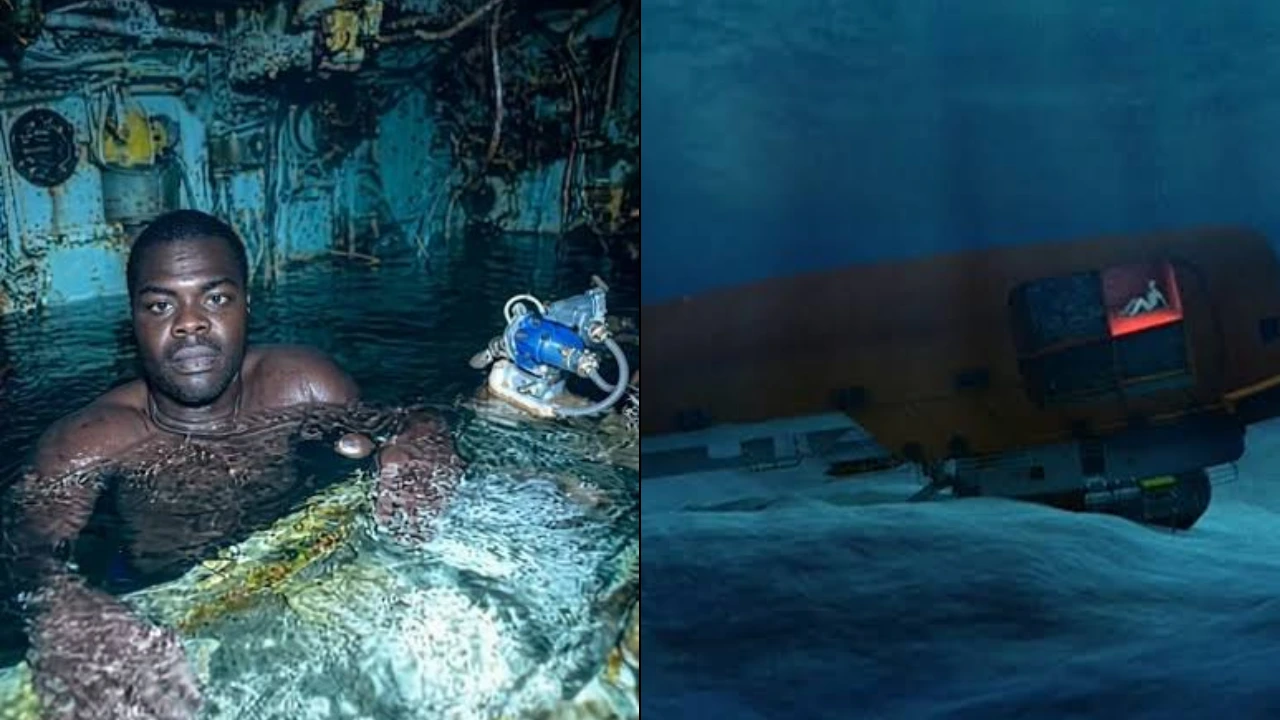
On the morning of May 28, 2013, commercial diver Nico van Heerden pulled himself through the flooded corridors of the upturned Jascon-4, a tugboat that had been sitting on the Atlantic seabed for two days. He was there to recover bodies. Sixty-five nautical miles away, his supervisor Colby Werrett was monitoring the helmet camera feed from the Lewek Toucan’s control room.
Van Heerden’s torch cut through the murk. Then he saw a pale hand floating in the water ahead of him. He reached to pull it free. The hand grabbed back.
The tugboat went under at dawn
At approximately 4:50 a.m. on May 26, 2013, Harrison Odjegba Okene was in the shared bathroom of the Jascon-4, a 31-metre tugboat working about 20 miles off the coast of Escravos, Nigeria. The vessel was performing tension tow operations, helping stabilize an oil tanker at a Chevron platform during a rough Atlantic swell. Okene was 29 years old, and worked as the ship’s cook. He was due on shore leave in three days.
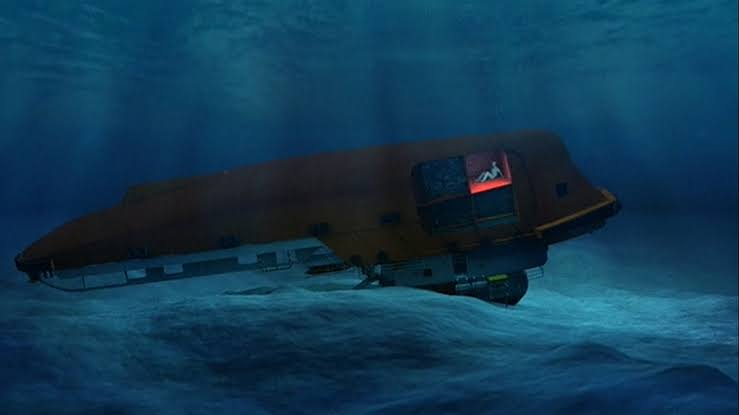
A rogue wave struck without warning. The Jascon-4 heaved over, inverted, and sank to the seabed at a depth of around 30 meters. It came to rest upside down, balanced on its masthead. The descent took less than two minutes.
Okene was thrown from the bathroom into the passageway as the ship went over. Three of his crewmates were just ahead of him, fighting toward the emergency exit hatch. The water came in behind them. He watched all three disappear into it. “I saw the first one, the second one, the third one just washed away,” he later told Reuters.
He turned back. Swimming deeper into the sinking ship was against every instinct. But the exit was already gone.
Okene survived in the dark
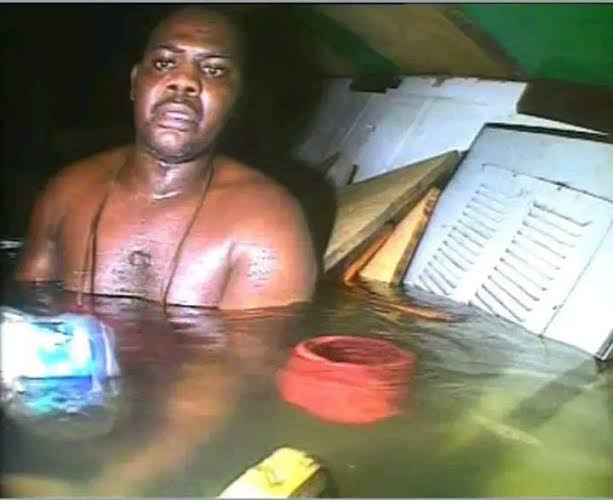
The force of the water swept him through the passageway and into the second engineer’s cabin, and from there into its attached bathroom. When the ship settled on the seabed, the bathroom had not filled completely. There was an air pocket, roughly four feet high, trapped between the inverted floor and the rising water.
For the next 60 hours, that pocket kept him alive.
The rest of the Jascon-4’s crew had been asleep in their locked cabins when the wave hit. Security protocol required cabin doors to be locked at all times, a standard precaution against piracy in those waters. That same protocol had locked them in. Okene heard their voices in the minutes after the sinking, filtered through metal walls and flooded corridors. One by one, the voices stopped.
Working in pitch darkness, he broke the bathroom vent, used a strip of steel from it to lever open the cabin door, and began searching the wreck. He found two life jackets with torches. He found a tin of sardines and a can of cola. He tore coveralls into strips, tied them into a rope, and ran one end back to the bathroom so he could feel his way home through the blackness. He pulled wooden ceiling panels free and lashed them into a raft, to keep himself out of the cold water.
Crayfish moved through the water and bit at his legs, torso, and arms. He ate the sardines, drank the cola, and prayed. He sang church songs in the dark. The air pocket shrank as carbon dioxide accumulated with every breath. He had no way to know whether the ceiling would hold, whether the ship would shift, or whether anyone was coming.
The Lewek Toucan came for bodies
When the Jascon-4 sank, one of the convoy ships put out a distress call on Channel 16. A helicopter searched through the rest of May 26. No survivors were found. The search was canceled that evening. West African Ventures, the company that operated the Jascon-4, then contacted the Lewek Toucan, a dive support vessel working 65 nautical miles away, and tasked its team with entering the wreck and recovering the dead.
The Lewek Toucan carried six saturation divers. At the moment the call came in, they were already 70 meters down, laying oil pipes. Getting to the Jascon-4’s resting depth of 30 meters was not simple: their bodies had absorbed nitrogen and helium equivalent to their working pressure, and decompression would take nearly 20 hours. The ship was also sailing into the same storm that had sunk the Jascon-4, which slowed the crossing to about 4 knots. The sailing time and the decompression time were almost identical.
The vessel arrived late on May 27. By the afternoon of May 28, dive team two had already recovered four bodies from the Jascon-4’s interior. Nico van Heerden, the penetration diver, was working further into the wreck. André Erasmus waited in the dive bell. Darryl Oosthuizen fed van Heerden’s umbilical line from outside the hull. Above them, on the Lewek Toucan, Colby Werrett watched the helmet camera.
A hand reached through the water
Van Heerden saw what looked like a body ahead of him in the murk. A pale hand, drifting. He reached for it.
The hand closed around his.
Okene had been watching a faint reflected light somewhere below his raft. He dove toward it, found nothing, surfaced, filled his lungs again, and dove a second time. In the helmet camera footage, still widely circulated, the moment is visible: the torch beam, the floating palm, and then the grip.
Werrett’s voice on the intercom came before he had fully processed what he was seeing. “There’s a survivor in there.”
The immediate problem was the air. Okene had been breathing recycled air for nearly 60 hours and the carbon dioxide level in the pocket was dangerous. Van Heerden purged gas from his helmet into the pocket, carefully. Too much and the added buoyancy would destabilize the wreck, balanced as it was on its masthead. A Kirby Morgan dive helmet was prepared on the Lewek Toucan and sent down. When it was on Okene’s head, van Heerden guided him through the flooded passageways to the dive bell.
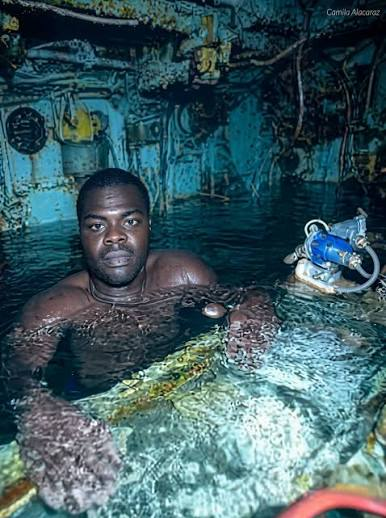
The ascent took three more days
Okene could not simply go up. He had spent 60 hours breathing compressed air at depth, and his body had absorbed nitrogen equivalent to the surrounding water pressure. Brought straight to the surface, the dissolved gas would expand in his blood and tissues. Decompression sickness, known as the bends, can be fatal. He entered the Lewek Toucan’s decompression chamber instead, where pressure was reduced by increments over three full days.
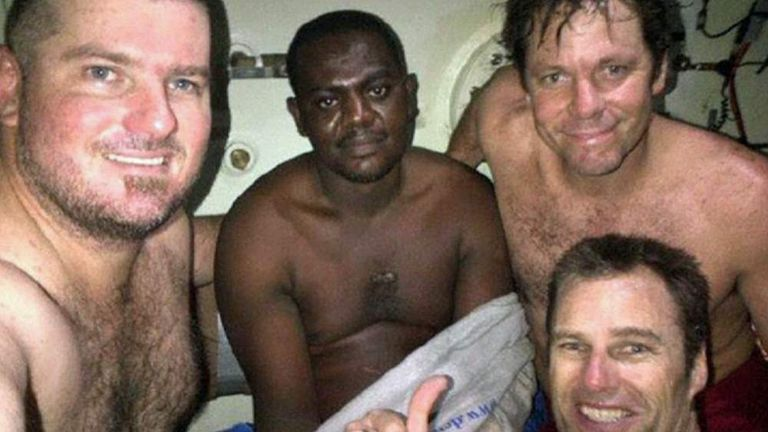
Van Heerden stayed at his side throughout. He fed Okene, administered medication under the guidance of a hyperbaric doctor consulted remotely, and nursed him through the slow descent toward normal pressure. When the chamber finally reached the surface and Okene stepped out, his vital signs were normal. His temperature, blood pressure, and pulse were as though nothing had happened. He struggled to believe it.
Ten of his eleven crewmates had been recovered from the Jascon-4. The eleventh was never found.
Okene went back into the water
The weeks after his return home were harder than the 60 hours at the bottom. Media gathered at his front door. At night, he dreamed of the bed sinking beneath him, would grab his wife and try to force a door that wasn’t there. He saw a psychologist, but what she said, as he told The Guardian in 2023, “was not saying anything that made sense to me.”
The following year, his car went off a bridge in Port Harcourt and into the water. He got out, realized his friend was still inside, swam back and pulled him free. Later, he dove again to tie a recovery rope around the submerged car. Standing at the roadside afterward, he asked himself what exactly he was afraid of.
He enrolled on a commercial diving course in 2015, and told his brother only after he had finished it.
By 2023, Harrison Okene was working as a diver on oil and gas infrastructure, operating at depths of up to 50 meters. He has a partner and three children. He has a house beside a lake. When he has the money, he says, he will buy one beside the ocean.
