
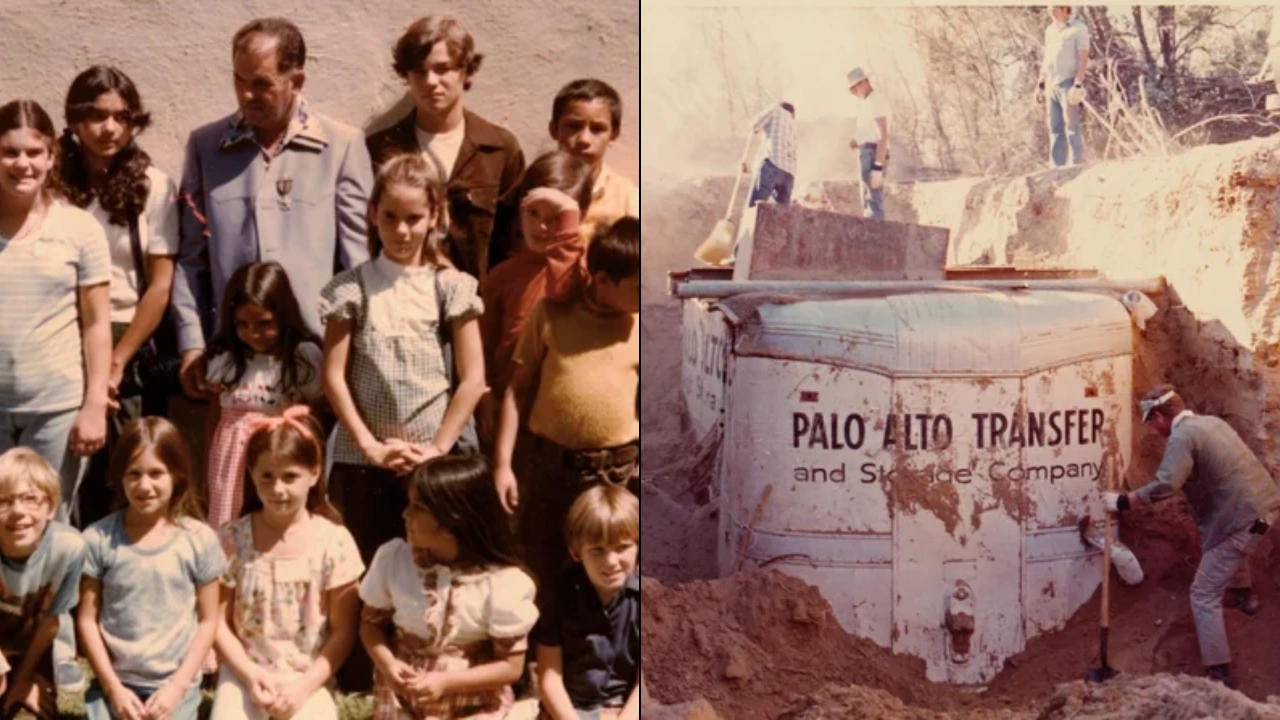
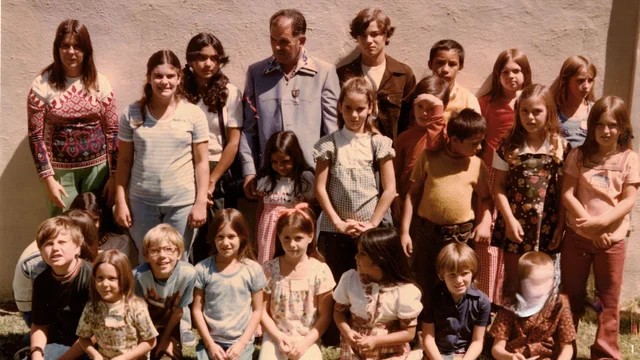
July 15, 1976, was supposed to be an ordinary Thursday. Frank Edward “Ed” Ray, a 55-year-old school bus driver with 26 years behind the wheel and not a single late return in his record, was driving the last stretch home with 26 Dairyland Elementary School children after a summer swim trip to the Chowchilla Fairgrounds pool. At approximately 4 p.m., a white van appeared in the road ahead of him, parked sideways across both lanes with its doors hanging open.
Ray slowed to a stop. Perhaps, he thought, whoever owned it needed help. He had only a moment to consider this before three men climbed out, wearing nylon stockings over their faces, carrying a pistol and a sawed-off shotgun. One of them tapped on the bus door with his gun and asked Ray, with an unsettling calmness, to open it.
Ray had 26 children in his care. He opened the door.
Three men in nylon masks took the wheel
The hijackers moved fast. One pulled Ray from his seat and took control of the bus. A second herded the driver and the children to the back at gunpoint, where 26 kids, most of them still in their swimming clothes from earlier in the day, stared down the barrel of a shotgun. A third climbed back into the white van and followed from behind.
Six-year-old Larry Park, pressed into the back of the bus with the others, wondered how it was going to feel to die.
The bus was driven off the road and into a thick stand of bamboo alongside Berenda Slough, a shallow dry branch of the Chowchilla River, nine miles outside of town. The kidnappers had prepared precisely for this: a second van was already hidden nearby. Both vans had been modified to move people without anyone noticing. The rear windows were painted black, the interiors lined with soundproof paneling. Even if the children screamed, no one outside could hear them.
The kidnappers divided the 26 children between the two vans. As each child stepped through the door, one of the men recorded their name and age on a Jack in the Box hamburger wrapper.
Ten-year-old Jody Heffington stood at the front of the second van’s line while the first van drove away into the dark. The cold metal of a shotgun barrel was pressed against her stomach as she waited. “I thought he was going to shoot me,” she said later. “I actually did.”
The vans drove south through the night
For the next 11 hours, the children traveled in complete darkness with no ventilation, no food, no water, and no sense of where they were going. The youngest ones cried. The older ones tried to hold it together for the smaller children. Jennifer Brown Hyde, nine years old, later said she felt like “an animal going to the slaughterhouse.” She was trying not to show it because five- and six-year-olds had come to lay against her.
By the early morning hours of July 16, the vans had traveled roughly 110 miles south and east to the California Rock & Gravel quarry in Livermore, California. The property belonged to the family of one of the kidnappers, a fact they apparently considered an advantage.
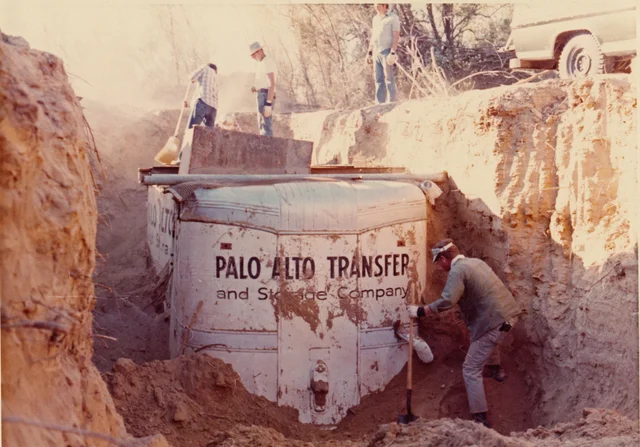
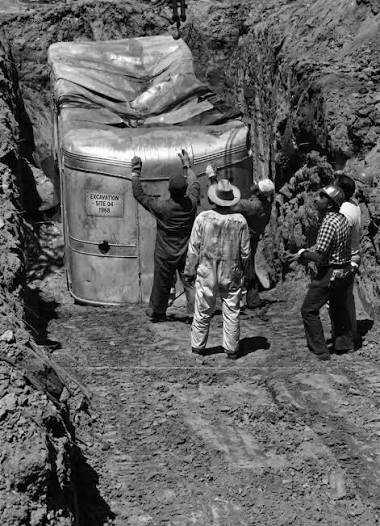
The children were forced out at gunpoint, one at a time, and directed to a hatch in the ground. Below the hatch, down a ladder, was a truck trailer that had been buried and converted into a bunker. The kidnapping had been in planning for over a year, and this part of the plan had required more than a year’s preparation: the trailer was confirmed to have been buried at the quarry in November 1975, more than eight months before the abduction. Inside were worn mattresses, a few dim lights, two PVC pipes connected to ventilation fans, a small supply of food and water, and holes cut into the wheel wells to serve as toilets.
The kidnappers threw down a single roll of toilet paper, told the children they would return, then sealed the hatch from above with a heavy sheet of metal weighted down by two 100-pound industrial batteries. Then came the sound of dirt being piled on top.
As the last child descended, the 14-year-old Michael Marshall, the oldest among the group, heard his name being called from below. The other kids were still alive.
What no one had noticed, not the prisoners and not the kidnappers, was that in sealing the hatch, they had buried the ventilation pipes as well. The air supply for 27 people trapped 12 feet underground was now failing.
The ceiling began to bend
Hours passed. The children sang songs. As exhaustion settled in, the words shifted into something grimmer: “If you’re sad and you know it, clap your hands.” One of the youngest survivors later described the buried trailer as “a giant coffin for all of us.”
Ed Ray moved through the cramped space from child to child, patting their backs, wiping their tears, telling them to rest and save their strength. He was just as terrified. He didn’t let it show.
After 16 hours underground, Ray looked up and saw that the ceiling had begun to bow inward from the weight of the earth pressing down from above. He said nothing to the children. But he kept watching it.
Then dirt began seeping in through the edges.
The youngest children screamed. The ceiling was giving way. If they did not get out of the trailer immediately, the ground above them was going to come through.
Michael Marshall looked at the sealed hatch and made a decision. He dragged the old mattresses into a pile beneath the opening, stacked them, and climbed to the top. He pushed at the metal cover with everything he had. It didn’t move. Ray climbed up alongside him, and together they pushed until the cover shifted just enough for Michael to wedge a loose wooden beam into the gap. Using it as a lever, both of them shoved one final time.
The hatch broke free. Two 100-pound batteries crashed down into the trailer. Miraculously, they hit no one.
But the hatch was only the first obstacle. Above it sat a heavy plywood box, packed down with dirt and debris. Michael climbed up into it and started digging with his bare hands. Other children joined him, scraping at the earth until a chunk broke away. Through the gap came the most light any of them had ever been glad to see.
Six-year-old Larry Park later described it as “the most glorious ray of sunlight that I had ever seen.”
All 26 children and Ed Ray climbed out of the ground.
Investigators found the evidence waiting
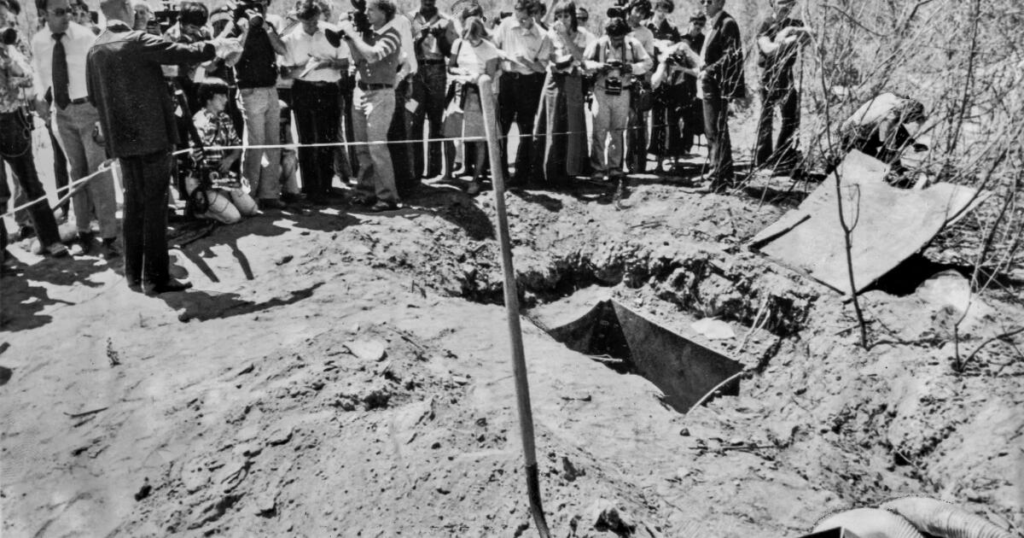
The survivors moved carefully through the quarry in the dark, past abandoned excavators and towering mounds of excavated earth, uncertain whether their kidnappers were waiting somewhere nearby. They weren’t. A quarry security guard spotted the group and called the authorities immediately. Alameda County Sheriff’s Deputies arrived within minutes and drove the children to Santa Rita, the nearest facility with medical staff, where doctors and EMTs examined them and gave them food and water for the first time in nearly two days.
Shortly before dawn on July 17, 1976, the survivors were driven back to Chowchilla in a police-escorted bus, almost 32 hours after they had vanished. The community that had held vigil through two days and nights wept openly when the bus pulled up.
All 26 children and their bus driver had made it out alive. They had made it out without anyone coming to save them.
Law enforcement moved quickly to the most obvious lead. The quarry was private property, and access to the specific section where the buried trailer had been found was restricted. Among the small number of people with keys to that area was 24-year-old Frederick Newhall Woods IV, the son of the quarry’s owner.
A search warrant was executed for the Woods family estate, Hawthorne, a 78-acre property in Portola Valley. In Frederick Woods’ room, investigators found everything: journals, a draft of the $5 million ransom demand, maps of the planned drop site in the Santa Cruz Mountains, receipts for the vans and the buried trailer, false identification documents, one of the guns used in the hijacking, and the Jack in the Box hamburger wrapper with every child’s name and age written on it.
The ransom plan had been elaborate. The money was to be dropped from a plane into the mountains at night, with aircraft patrolling a 200-mile corridor to prevent any ground surveillance of the drop. The kidnappers had spent more than a year refining every step. They never got to use any of it.
When the children were hijacked on the afternoon of July 15, the Chowchilla Police Department’s telephone lines were immediately jammed with incoming calls from families, media, and people across the country. When the kidnappers tried to call in their demand, they could not get through. They decided to try again later. They fell asleep. When they woke up, the news was on television: the children had escaped.
The plan was finished. The money was never collected. According to Wikipedia, one stated purpose for the ransom was to fund the restoration of the Victorian Rengstorff House in Mountain View, California.
The sentences came, then the appeals
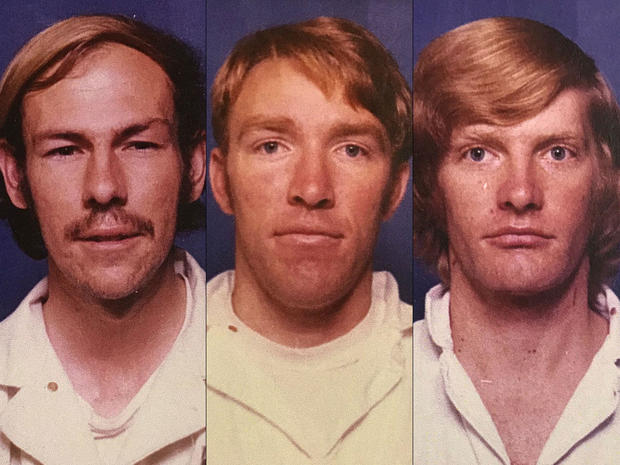
The three kidnappers were not professional criminals. Frederick Newhall Woods IV, James Schoenfeld, and Richard Schoenfeld were all 22 to 24 years old, from wealthy and well-connected Bay Area families. Woods’ father owned the quarry. The Schoenfeld brothers were sons of a respected podiatrist in Atherton. All three had previously been convicted of motor vehicle theft and received probation, consequences that their family connections had softened considerably.
By 1976, their parents had cut off the financial support that had been sustaining their adult lives. Facing debt and unwilling to change course, they spent more than a year planning a single crime they believed would restore everything.
James Schoenfeld later explained the logic in one sentence: “We needed multiple victims to get multiple millions and we picked children because children are precious. The state would be willing to pay ransom for them. And they don’t fight back.”
Eight days after the kidnapping, Richard Schoenfeld surrendered voluntarily to authorities in Oakland on July 23, 1976. Two weeks later, James Schoenfeld was arrested in Menlo Park, California. Later that same day, Frederick Woods was arrested by the Royal Canadian Mounted Police in Vancouver, British Columbia.
All three pleaded guilty to 27 counts of kidnapping for ransom and robbery. At trial, they were also found guilty of inflicting bodily harm, which under California’s penal code carried a mandatory sentence of life in prison without the possibility of parole. The judge sentenced all three accordingly.
Four years later, an appellate court overturned the bodily harm conviction. The physical injuries the children had sustained, mostly cuts and bruises from digging themselves out, did not meet the legal threshold for bodily harm as written in the statute. The three men were resentenced to life with the possibility of parole.
For the survivors, the legal fight had just started.
For more than four decades, the children who climbed out of that quarry were required to return, again and again, to sit in the same rooms as the men who had put them underground, opposing their release at parole hearing after parole hearing. Jody Heffington, who had been ten years old when a shotgun was pressed into her stomach, became one of the most persistent voices in those proceedings. At one hearing, sitting across from Frederick Woods, she told him directly: “You’re a thief of lives. Not just the kids that were in the bus. You stole our family’s lives and what we all had before that.”
Richard Schoenfeld was paroled in June 2012 after 36 years. James Schoenfeld was paroled on August 7, 2015, after 39 years. Frederick Woods, who had accumulated multiple disciplinary violations in prison, including possession of contraband pornography and cellphones, was denied parole 19 times before being released on August 17, 2022, at the age of 70. Governor Gavin Newsom asked the board to reconsider. The board affirmed its decision.
In 2016, the 25 surviving victims settled a civil lawsuit against their kidnappers. The money came from Frederick Woods’ trust fund, described in court filings as worth approximately $100 million, though Woods’ legal team disputed that figure. One survivor said they received enough “to pay for some serious therapy, but not enough for a house.”
The survivors carried the weight for decades
Studies conducted in the years after the kidnapping found that the survivors experienced panic attacks, persistent nightmares, and lasting personality changes. Many developed fears rooted in ordinary things: cars, darkness, kitchens. A number struggled with substance abuse and depression for years. Many continued to report symptoms of trauma more than 25 years after the event.
Larry Park, who had been six years old and had wondeed quietly how dying would feel, spent years battling addiction and schizophrenia before eventually finding sobriety. He became a pastor. “My resentment for them was killing me,” he said later. “The moment I forgave them I finally felt peace.”
Jennifer Brown Hyde built a life she described as a happy one. It took decades before she could sleep without a nightlight. “That little girl that was kidnapped and buried alive,” she said, “managed to live a wonderful life.”
Michael Marshall, who had been 14 years old when he jammed a wooden beam into the hatch and pushed until it broke, became a truck driver and a father. He never forgave the kidnappers. “What they put my mom and dad through,” he said, “is something I cannot forgive.”
Jody Heffington did not live to see the last of them walk free. She reportedly passed away in 2021 at the age of 55. Her son described a woman who had stopped eating, consumed by depression she could not find her way through. She had given decades to those hearings, and in the end the hearings had not gone the way she needed them to.
Ed Ray, who had kept 26 terrified children calm through 16 hours of darkness and helped force open the hatch that freed them, received a California School Employees Association citation for outstanding community service. He remained a beloved figure in Chowchilla until his death on May 17, 2012. In 2015, the city renamed its largest park in his honor and declared February 26, his birthday, as Edward Ray Day.
The Chowchilla kidnapping eventually changed how California law addressed psychological harm. It became one of the most-studied cases in the early understanding of childhood trauma and PTSD, influencing how the effects of those experiences were recognized, documented, and treated for years afterward.
All three kidnappers are free today. The children they buried alive in the summer of 1976 have carried what happened to them in every year since, in ways no parole ruling was built to account for.
