
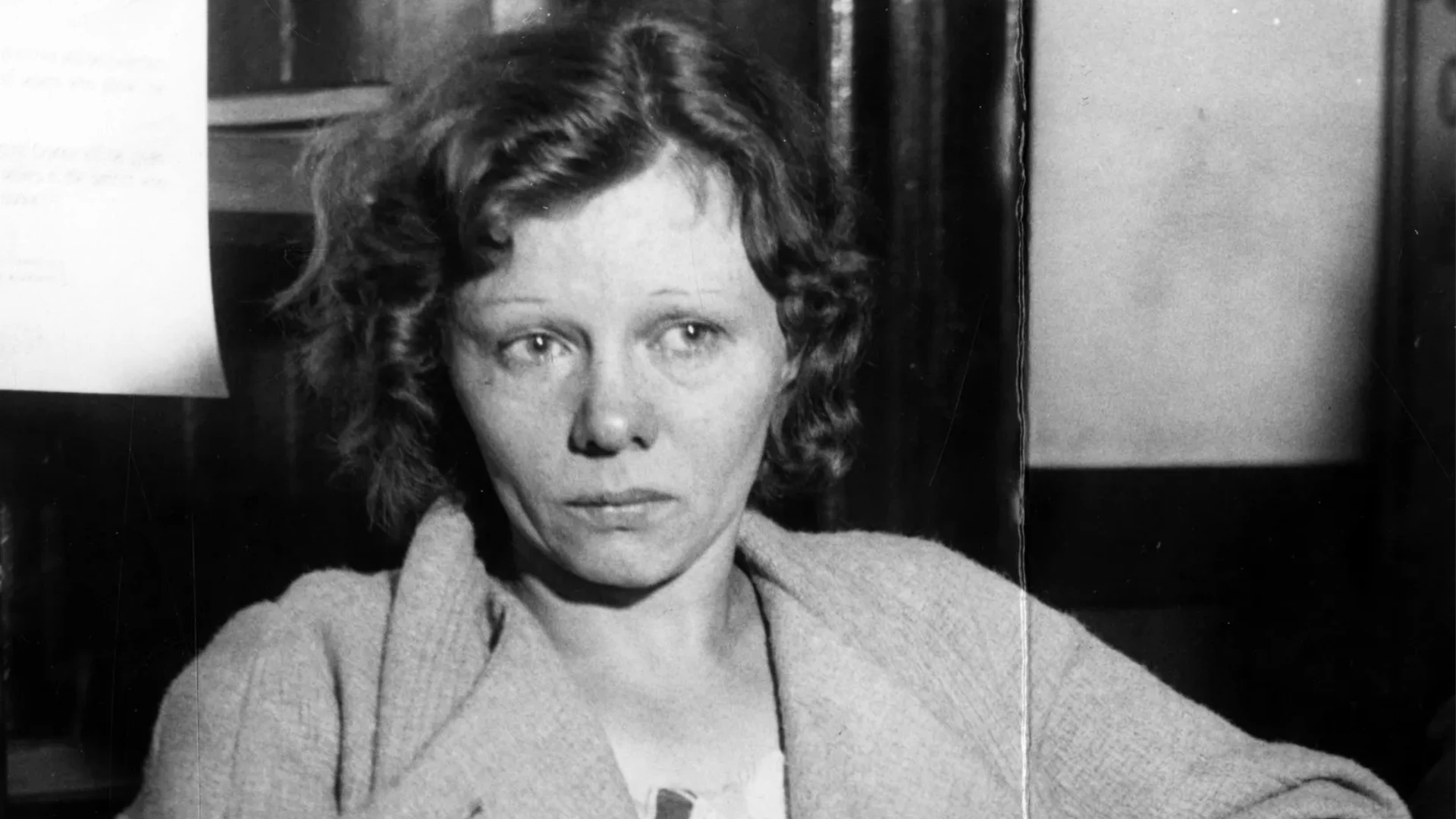
On the morning of August 8, 1940, Eleanor Jarman and a fellow inmate named Mary Foster stole clothing from prison staff at the Dwight Correctional Center in Illinois, climbed a 12-foot perimeter fence topped with barbed wire, and hitchhiked out of sight. When the women failed to appear at lunch, staff conducted a thorough search. They found nothing except that two sets of staff clothes were missing. The women’s prison uniforms turned up later in a field less than a mile from the penitentiary.
Jarman was 39 years old. She had been serving a 199-year sentence for her role in a murder she had not committed. She would spend the next several decades living under an assumed name, maintaining secret contact with her family through coded messages placed in classified newspaper advertisements. She would never be caught.
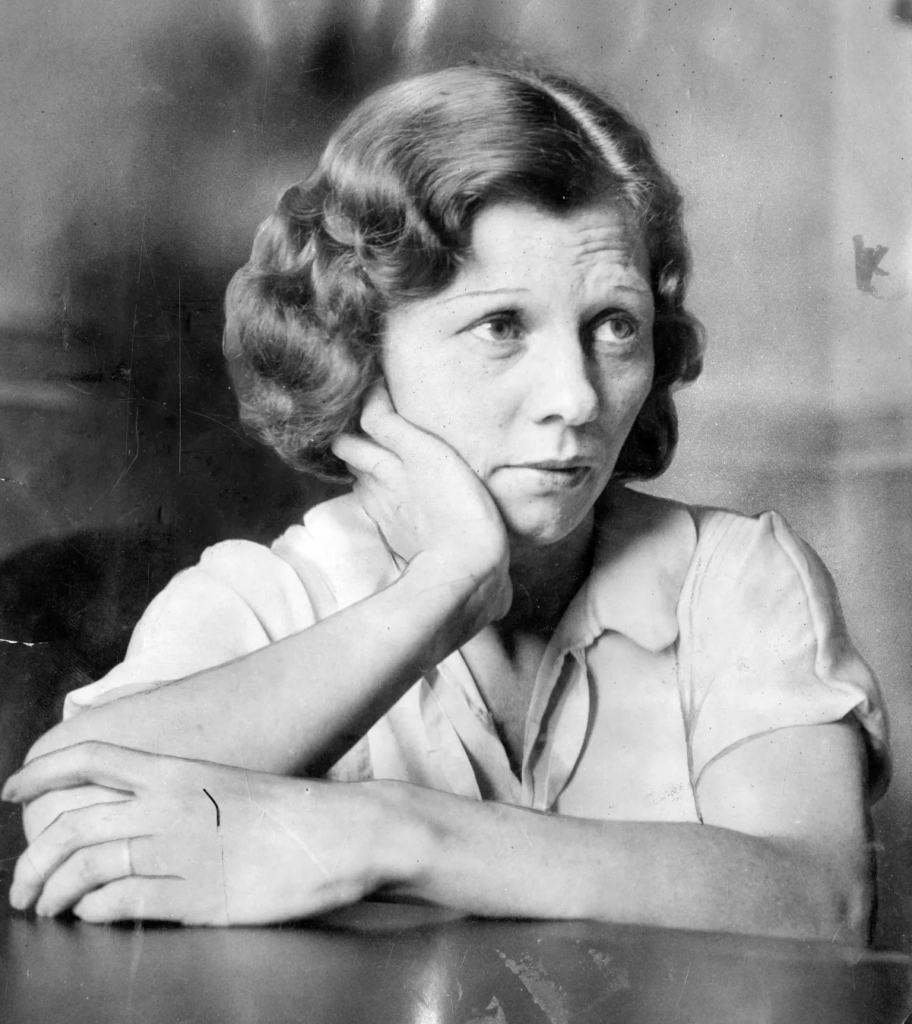
A Life Built on Little
Eleanor was born Ella Marie Berendt on April 22, 1901, in Sioux City, Iowa, one of twelve children born to German immigrants Julius and Amelia Berendt. Three of those children died young. The family was poor. Eleanor left school before her teens and took work as a waitress at twelve years old, according to prison officials who later documented her history.
In 1920, she married Michael Roy Jarman. Together they had two sons, LeRoy and LaVerne, and the family moved to Chicago in 1923. Michael Jarman began drinking heavily and eventually stopped providing for them. Eleanor was left managing alone, working as a waitress and a laundrywoman and supplementing what she earned with government relief allotments.
During Prohibition, she reportedly ran a beer flat, an apartment used to distribute alcohol illegally. When Prohibition relaxed in the early 1930s and that income dried up, she needed another source of money. Through her various jobs she met George Dale, a factory worker five years her junior who supplemented his income by robbing small shops on Chicago’s West Side. Dale became her live-in lover. He operated with Leo Minneci, a former boxer who drove their getaway vehicle. In the spring and summer of 1933, Eleanor joined the crew.
The Robbery Crew
Their method was direct and violent. Minneci drove. Dale produced a pistol. Eleanor stood lookout or used a blackjack to subdue victims who resisted. Dale and Eleanor operated under the aliases Mr. and Mrs. Kennedy. Police would later suspect the trio in connection with up to 48 separate robberies across Chicago’s northwest side.
On August 4, 1933, the three set out to rob a haberdashery at 5948 W. Division Street on Chicago’s North Side. The owner, 70-year-old Gustav Hoeh, had spent decades running his shop on that street. One of the men walked in and requested a blue broadcloth shirt. While Hoeh rummaged through shelves and boxes looking for it, Eleanor greeted him warmly. Dale reached into her handbag and drew out a pistol.
Hoeh saw the gun. He saw Eleanor draw a blackjack. The second man went for the cash register. Hoeh fought back.
Eleanor struck him. Witnesses described her pummeling and clawing at Hoeh as Dale struggled with the storekeeper. He collapsed and released a scream, which caused Dale to misfire his weapon in the confusion. The trio scrambled for the door. With what strength remained in him, Hoeh crawled across the floor and grabbed Eleanor’s skirt as she tried to leave. She hit him on the head a second time.
Dale turned the pistol on Hoeh and fired four times. He left him bleeding on the pavement outside his own shop. As the trio moved toward the getaway car, Eleanor lingered. Then she turned and kicked the dying man.
A passing motorist noted the license plate of the blue sedan as it pulled away. That lead identified Leo Minneci, who was the first of the three to be arrested. He told police a story about a couple named Mr. and Mrs. Kennedy whose argument had turned violent inside the store. Police did not believe him, but the alias led them directly to Eleanor and Dale.
The Trial and Verdict
Officers went to 4300 W. Madison Street, the known address of Mr. and Mrs. Kennedy. Dale and Eleanor had already gone, taking her sons with them. Neighbors reported the couple had hosted wild parties at the apartment. A local druggist recalled Eleanor buying blonde hair dye.
Police tracked the couple to a second-floor apartment at 6232 Drexel Avenue, where both were found and arrested on August 9. Both had dyed their hair red. Recovered from beneath their pillows were four pistols and the blackjack.
The press moved faster than the courts. Within days of the arrest, Chicago newspapers had given Eleanor Jarman a name: the Blonde Tigress. The coverage was heavy and theatrical, comparing her to Bonnie Parker and casting her as proof that women could be as dangerous as any male criminal. It sold papers at a moment when the city was demanding that authorities prove they were not soft on crime. One paper pasted her photograph onto the neck of a jungle cat.
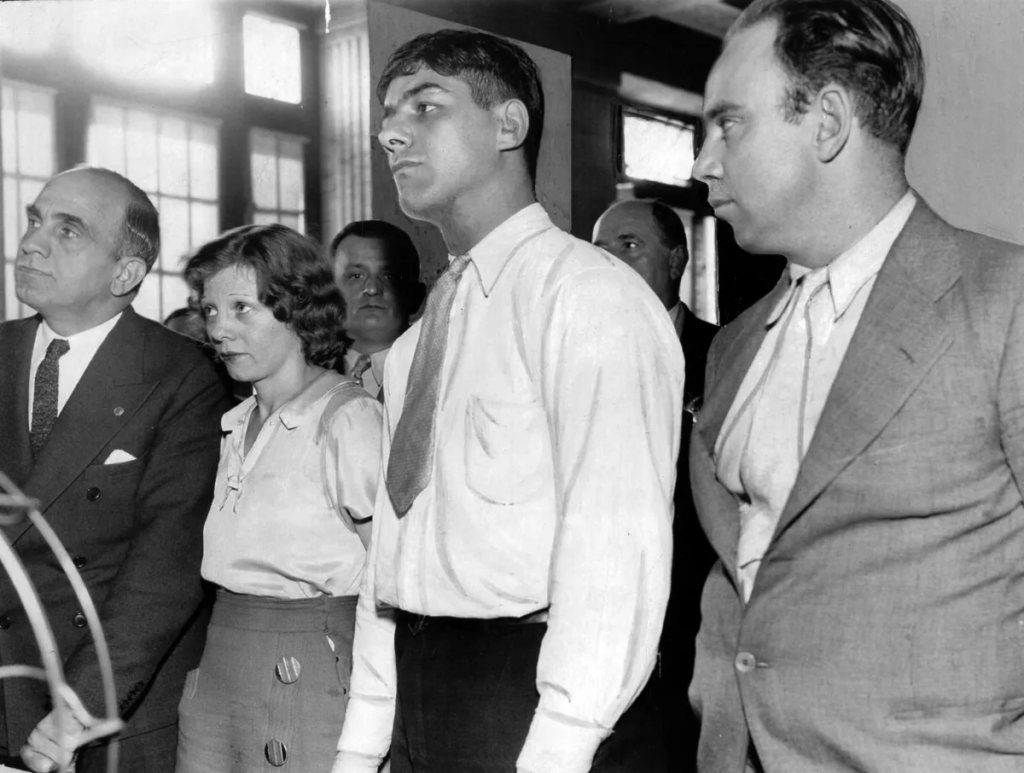
The trial lasted less than a week. It began August 28, 1933. By September 1, all three had been convicted. From the murder on August 4 to conviction on September 1 was fewer than thirty days. At trial, Eleanor and her co-defendants insisted that Gustav Hoeh’s death had been an accident. Sensing no sympathy from the jury, Eleanor spoke of her early struggles: married young, abandoned by her husband, left as a single mother with no money.
Before sentencing, Dale told the judge that another woman entirely, a Mary Davis, had been his accomplice, and that Eleanor had been waiting in the car and had not participated. The jury did not believe him either.
George Dale, the man who had pulled the trigger, received the death sentence. He was executed in the electric chair at Cook County Jail on April 20, 1934. He was 27 years old. The day before his execution, he wrote a love letter to Eleanor Jarman.
Eleanor Berendt Jarman was sent to the Illinois Penitentiary for Women at Dwight. Leo Minneci received a matching 199-year sentence and was eventually paroled in 1957. Under Eleanor’s sentence, she would not be eligible for parole until she was 95 years old. Her sons were placed in the care of her older sister Hattie and Hattie’s husband Joe Stocker, in Sioux City.
Seven Years, Then Gone
For the next seven years at Dwight, Eleanor Jarman was a model prisoner. Prison records showed no disciplinary infractions. She caused no trouble.
In 1940, word reportedly reached her that her sons were planning to run away from Iowa. She began planning with Mary Foster, a 39-year-old fellow inmate and mother of four who was serving a one-to-ten-year sentence for larceny following an arrest in Chicago in January 1939. Foster had escaped custody twice before: in 1936, she had jumped from a train transporting her to the federal women’s prison in Alderson, West Virginia, and in 1938 she had escaped from a workhouse in Cincinnati.
On the morning of August 8, both women completed their regular housework duties as normal. Around 11 a.m., they were last seen. When they failed to appear at lunch, staff conducted a full search of the buildings and grounds and found no trace of them. What they did find was that two sets of staff clothing were missing: a polka-dot dress and a blue suit. The women’s prison uniforms were recovered later that day in a field less than a mile from the penitentiary. A taxi driver confirmed he had picked up two women and dropped them in the center of Morris, in Grundy County, Illinois.
Eleanor Jarman was free. She reportedly traveled to Sioux City, confirmed her sons were safe, and disappeared entirely.
Life as a Fugitive
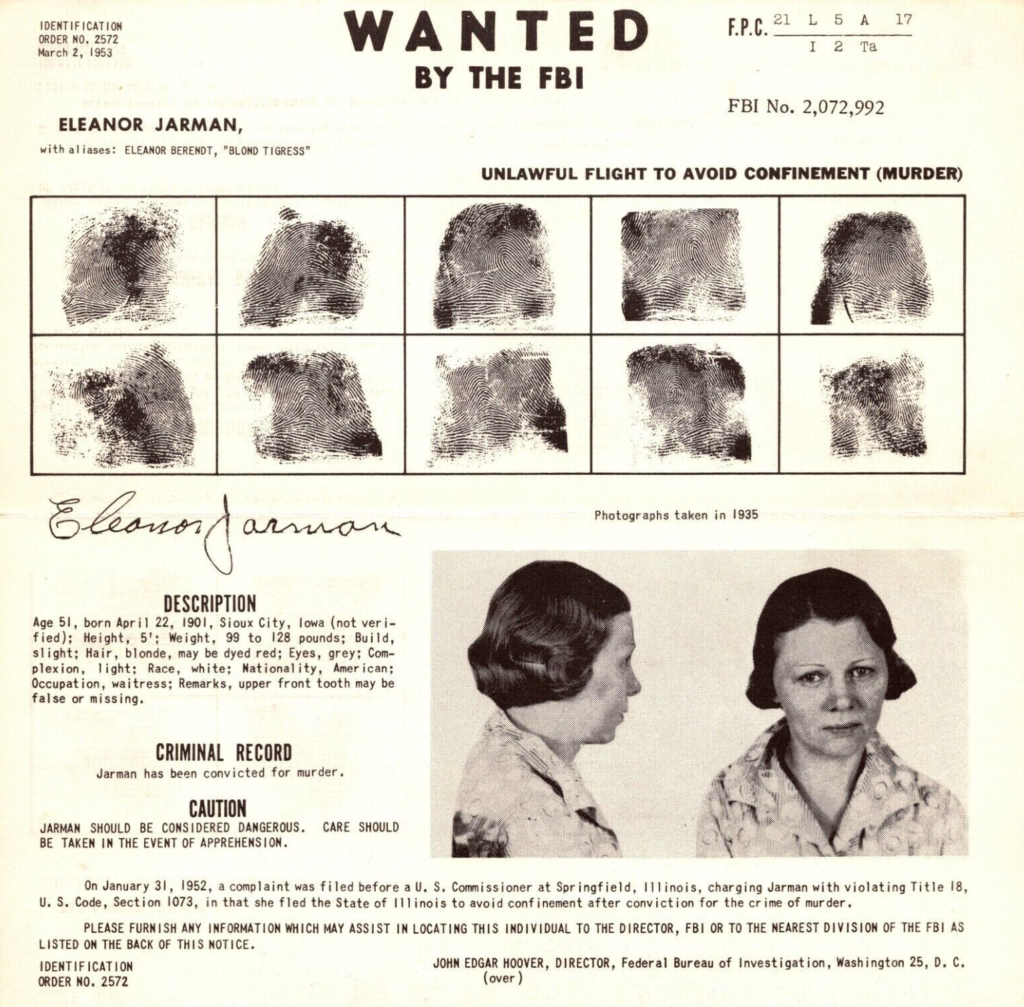
For the next 35 years, Jarman reportedly maintained contact with her family through coded messages placed in classified newspaper advertisements, including in publications such as the Kansas City Star. Simple phrases carried meaning the family recognized. According to her grandson Doug Jarman, who disclosed the arrangement to the Chicago Tribune, ‘let’s have coffee’ was one such code. No independent record of the advertisements has been verified.
Through these messages, Eleanor reportedly told her family that she had never remarried following the escape, and that she was working at a restaurant.
In 1975, she surfaced in person for the only confirmed time since leaving Dwight. She arranged a meeting with her brother Otto Berendt, his wife Dorothy, and her son LeRoy. They met at the Sioux City bus station and drove to a nearby lake to talk. Eleanor asked after her sons.
At one point during the meeting, a police car drove by. “Relax,” Eleanor told them. “They stopped looking for me years ago.” LeRoy urged his mother to return to Illinois and resolve the situation. She refused. “I have a lot of friends where I’m at,” she said. “They know the story.”
The meeting ended with Eleanor returning to the bus station alone. As Dorothy Berendt later told the Chicago Tribune: “I don’t think she wanted us to know what bus she was taking or where it was going.” That was the last time any of them ever saw her.
Contact through coded advertisements reportedly continued after 1975. The family said communication tapered off in the mid-1990s, after LeRoy died.
By 1993, Eleanor’s grandson Doug Jarman had grown determined to find her. That year, he showed the Chicago Tribune a letter he had recently received, sent to a former business address of his that an impostor would have been unlikely to know. “I am still alive,” it read. “They never caught me.
This is your notorious grandmother, ‘The Blond Tigress.’ I am in my 90s now and having some medical problems.” Doug hired an attorney and petitioned for a pardon on a straightforward argument: in the 53 years since she had climbed over the Dwight fence, Eleanor Jarman had not been arrested once. The petition was denied.
True crime author Silvia Pettem later pursued the case in her book In Search of the Blonde Tigress. Pettem’s research identified a woman named Marie Millman who appeared in Denver records beginning in 1951 and worked for decades as a waitress along East Colfax Avenue at establishments including a diner later known as Pete’s Kitchen. Millman died in 1980 and is buried in Plot 67 at Fairmount Cemetery in Denver’s Windsor neighborhood.
No records of Millman having any family have ever been found. The alias “Marie Mellman or Millman” had been provided by Doug Jarman, who said he received it from his father LeRoy. Pettem acknowledges the case for identification rests on that alias, the shared middle name Marie, and the trade Eleanor had always worked. “I’m 99.9 percent sure,” she has said. Jarman’s granddaughter and great-granddaughter later came to Denver to visit Millman’s grave and Pete’s Kitchen in person. No exhumation has been ordered. No DNA comparison has been made.
The Mystery Remains
From the morning she climbed over that fence in August 1940 until the mid-1990s when her family lost contact, Eleanor Jarman left no traceable record under her own name. No arrest. No confirmed sighting. No paper trail any authority has been able to follow. Her story was considered remarkable enough to inspire an episode of the television series Gang Busters. The woman Chicago’s press called the most dangerous woman alive may have spent the better part of four decades working restaurant tables in Denver, serving customers who had no idea who she was.
Gustav Hoeh was 70 years old when he was shot four times on the pavement outside his clothing store on W. Division Street. LeRoy and LaVerne Jarman spent their childhoods in Sioux City, raised by an aunt, with a mother who communicated through newspaper codes she hoped they would find.
Eleanor Jarman was born in 1901. She is presumed dead. Where she is buried, and under what name, remains unknown.
