
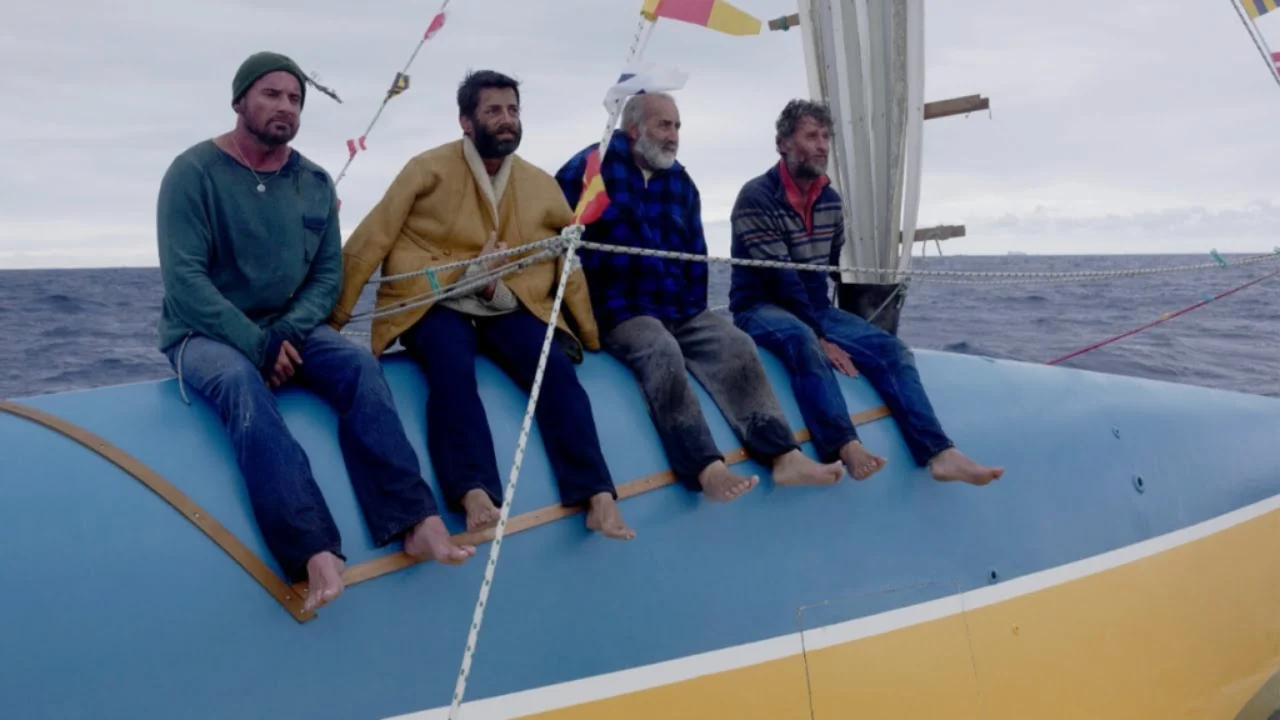
At approximately 6 am on June 4, 1989, somewhere in the southern Pacific Ocean, John Glennie heard a sound he recognized. Twenty years earlier, deep in the same stretch of ocean, a wall of water had cracked the hull of an earlier boat beneath him and nearly killed him and his brother. It had made this sound first: a low roar, building fast, like a freight train closing on a crossing. He had no time to react. A wave estimated at 60 feet picked up the 6.5-ton trimaran Rose-Noëlle and rolled her upside down. Below decks, crew member Phil Hoffman was thrown from his bunk and had to kick out the companionway doors to escape. In the seconds after the capsize, Glennie’s first reported thought was for the boat itself. Then he understood there was work to do.
Four men were trapped in the inverted hull of a trimaran, 140 miles off New Zealand’s East Cape, in the dead of winter. The New Zealand Water Safety Council would soon list all four as drowned in the vicinity of the Kermadec Islands. Within two months, they were officially mourned. The listing was wrong on every count. But they were completely alone, and no one was looking for them.
They drifted for 119 days.
A boat named for a ghost
John Glennie had been building the Rose-Noëlle for nineteen years when she sailed out of Picton.
The story behind the name had never been told publicly until recently. In July 1968, during Bastille Day celebrations in Papeete, Tahiti, a young woman named Rose Noel was crowned Miss July. Glennie, then cruising the Pacific with his brother David, photographed her and introduced himself. For years afterward, across thousands of miles of ocean, they wrote letters. She was studying at a girls’ school in Hawaii, then working at the airport in Papeete, placing garlands around the necks of arriving passengers. He was building a boat by hand in a peach orchard in West Pennant Hills, Sydney.
She was finally coming to see him when one of his letters came back with a single French word stamped across the front. Décédée. Deceased.
On July 22, 1973, Pan Am Flight 816 had taken off from Fa’a’a International Airport in Papeete carrying 79 passengers and crew bound for Los Angeles. Thirty seconds after takeoff, the Boeing 707 banked sharply left and crashed into the sea. Seventy-eight of the 79 people aboard were killed. Rose Noel was among them.
Glennie named the boat after her. A friend on the dock heard the story and offered a remark that Glennie would carry for the rest of his life: “Oh, she’ll look after you.”
Glennie was not a casual sailor. In the early 1960s, he and his brother David had built a 35-foot trimaran in their father’s farm shed in New Zealand’s Marlborough region, named it Highlight, and spent eight years cruising roughly 40,000 miles across the Pacific. An American sailing magazine eventually called them the Playboys of the South Pacific. But the sailing world of that era viewed trimarans with suspicion, and recent history had given Glennie reason to take that suspicion seriously. Arthur Piver, the American designer widely credited as the father of the modern multihull, had disappeared off the California coast in 1968 while attempting to qualify for the Observer Single-handed Transatlantic Race. No wreckage was ever found.
Glennie absorbed all of it and built one doctrine deep into his approach: a trimaran has no ballast keel dragging it to the bottom. Upside down, it is more stable than upright. If the Rose-Noëlle capsized, the crew would stay with the boat. The boat would keep them alive. He had said it plainly to doubters for years. “All we have to do is stay with the boat till we drift up on an island.”
On June 1, 1989, with three men he barely knew, he sailed her out of Picton Harbour. Rick Hellriegel, 31, was the youngest and most capable of the group, a married man who had persuaded his best friend to join the trip. That best friend was Jim Nalepka, 38, an American from Minnesota who cooked at the Outward Bound school across the bay and had never been sailing. Phil Hoffman, 41, had met Glennie because his family’s boat was docked directly behind the Rose-Noëlle in Picton. He had undergone triple bypass surgery three years earlier and had never sailed outside New Zealand. His wife Karen had known him since she was 11 years old.
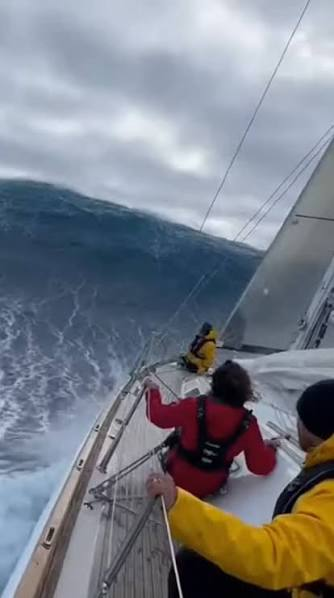
The wave, June 4
Three days out, the barometer began to fall. A southerly gale built to 40 knots, then 60. Glennie reefed the sails, ran with the wind, and trailed a drogue off the stern to slow the boat. When running was no longer safe, he deployed a 24-foot military parachute sea anchor off the bow on 300 feet of nylon rode, a standard storm tactic documented in every seamanship manual. For ten hours, it held the Rose-Noëlle’s bow into the oncoming seas.
Then the trip line failed. Parachute anchors are typically rigged with a light retrieval line at the crown, allowing the crew to collapse and recover the chute without fighting the full force of water inside a deployed parachute. That line fouled against the canopy and collapsed it. Without the anchor holding her bow, the Rose-Noëlle swung beam-on to the waves. For a trimaran riding light on top of the water rather than cutting through it, that orientation is particularly dangerous. Glennie would say later: “Next time I won’t use a trip line.”
The storm briefly appeared to ease toward morning on June 4, but the apparent lull was a trap. When strong sustained wind drops suddenly, it releases intersecting swells from different directions to stack against one another. Two crests meeting can double in height without warning, producing a steep breaking wall with no dominant direction a crew can steer toward or away from. That is what was waiting for the Rose-Noëlle. The roar arrived at approximately 6 am. The wave was estimated at 60 feet. It picked the trimaran up and rolled her in seconds.
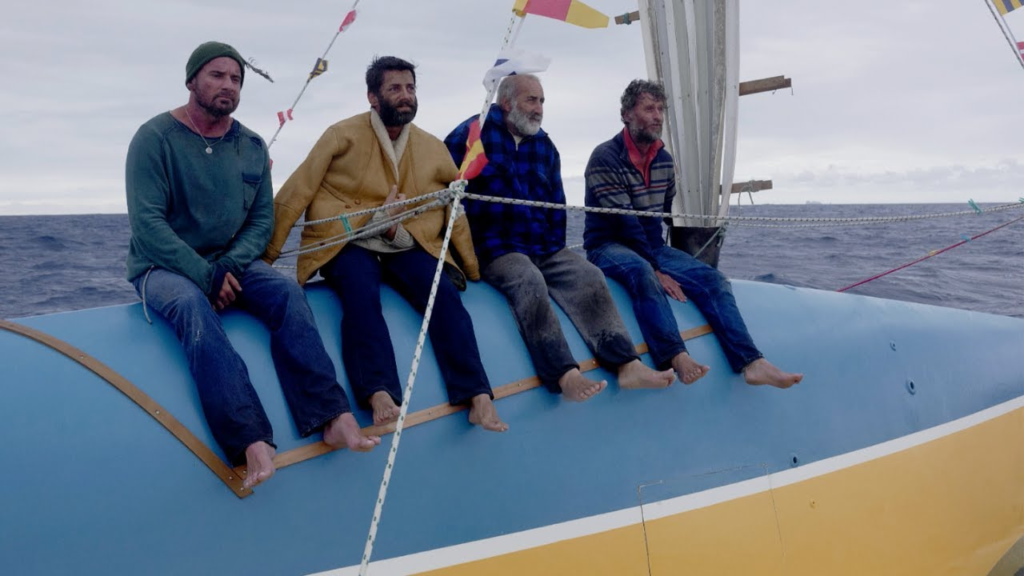
119 days inside the wreck
An upturned trimaran is not a lifeboat. It is a dark, wet cavity with roughly 18 inches of usable headroom, once the crew built a sleeping platform from salvaged cupboard doors, drawers, and life jackets. Four men lived on that platform for 119 days.
The 140 liters of fresh water had drained immediately through the tank vents when the hull inverted. For the first 40 days, the daily ration was approximately three ounces of soft drink per man. Glennie had stowed apples before departure, and they floated. Muesli and kiwifruit kept them alive through the first weeks. In the middle stretch of the ordeal, the ration dropped to two teaspoons of uncooked rice per man per day. “We all dived for every grain of rice that fell from the spoon,” Glennie later recalled.
On day 40, within an hour of Glennie completing a rain catchment system built from a spinnaker pole, split plastic conduit, and a bucket, it rained.
The hull’s topsides had never been treated with antifouling paint, not being designed to spend time underwater. Goose barnacles and mussels began colonizing the submerged surfaces. The Rose-Noëlle was becoming a floating reef, and reefs attract fish. Yellowtail kingfish came to feed on her. The crew fashioned a gaff from a sail batten and a fishhook. Phil Hoffman, who had been the most helpless of the crew in the immediate aftermath of the capsize, turned out to be deadly with it. The others nicknamed both the gaff and its operator the Wand.
Jim Nalepka, the cook from the land of 10,000 lakes who had never been to sea, now prepared raw fish cured in vinegar with lemon pepper, pan bread from flour and yeast, and drew on the spice locker Glennie had stocked for a Pacific cruise. On day 100, with a menu planned 50 days in advance, the four men ate burritos with baked beans, hand-rolled corn chips, and Glennie’s own dried chili. Presumed drowned. Upside down in the southern Pacific. One hundred days from home.
The EPIRB beacon had lasted nine days. The unit aboard the Rose-Noëlle was an older 121.5 MHz model that transmitted no vessel identification and no position data, detectable only by passing aircraft or vessels within roughly 100 miles, or by satellite if a ground-based relay station happened to be within range. New Zealand had no such ground station in 1989. The signal blinked into an empty sky for nine days, then the battery died. By that point, garbled radio transmissions relayed from another vessel had placed the Rose-Noëlle 600 miles from her actual position. An Air Force search aircraft spent two days looking in the wrong ocean and went home. The Water Safety Council’s bulletin listed all four men as drowned.
The four men were not harmonious. The three crew blamed Glennie for the capsize. Nalepka later wrote that from the moment the boat went over, Glennie was no longer captain in any meaningful social sense. They fought over half a biscuit, over inches of shared mattress, over which portions of the platform a man was permitted to occupy. Rick Hellriegel and Nalepka, former best friends, admitted years later there were days when they could barely contain their rage. During the 17 to 20 gales reported in the southern Pacific that winter, all four men lay in the cramped cavity for four and five days at a stretch.
Through all of it, Glennie kept diving into the flooded access below the platform to bring up food, gear, and supplies. Winter ocean, no wetsuit. He surfaced so hypothermic each time that the rest of the crew had to press their bodies against his to raise his core temperature. They did this for a man they openly blamed and resented. Without him, they almost certainly would not have survived.
Near the end, a ship passed within signaling distance. Glennie refused to signal it. The other three men scrambled toward the hull to wave it down anyway, and by later accounts, Glennie came closer to violence in those seconds than at any point in 119 days. His reasoning, to the extent it has been reconstructed: he had navigated them within reach of home. The boat was about to deliver them. To leave now would mean surrendering the boat, and the boat, he believed, was nearly finished with her work.
The two books written about the ordeal, one by Glennie and one by Nalepka, agree on the basic facts. On almost everything else, they do not.
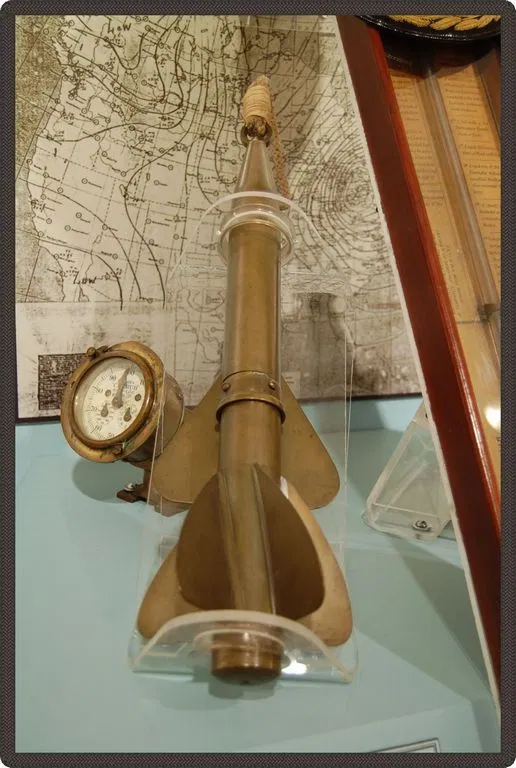
Navigation by contrail
Glennie had no functioning instruments, no reliable charts, and no GPS. He navigated by observation.
He tracked the headings of passing yachts with a hand bearing compass, vessels too far away to signal but close enough to read their courses. He then reasoned backward: from each heading, what port of origin and what port of destination would produce that track? That narrowed the geography. Then came the aircraft. Every Sunday, a plane on a consistent north-south track. On the third Sunday, the aircraft was still climbing, which meant it was close to its departure airport. From its heading and altitude, Glennie estimated their position at roughly 80 miles from Auckland. He had fixed his latitude and longitude using scheduled commercial air traffic, a hand bearing compass, and nothing else. His answer put them off Great Barrier Island.
On October 1, 1989, after 119 days, the cliffs of Great Barrier Island came out of the murk. The sea drove the upturned hull toward a coastline of nearly unbroken rock and put her ashore through what local sailors describe as the only navigable gap in that stretch, at Little Waterfall Bay. The Rose-Noëlle broke apart on the rocks and sank. Four men climbed the cliff in the dark, in winter, on legs that had barely supported their weight in four months.
They found an empty holiday home. They broke in. They bathed, shaved, raided the wardrobe and the pantry, cooked a meal, and opened the wine cellar. They said grace together. They slept in beds. That night, before the world knew they were alive, Glennie sat at a stranger’s desk and wrote a letter to a journalist friend. “I’ve lost everything except what matters most. And I’m extremely lucky to be alive.”
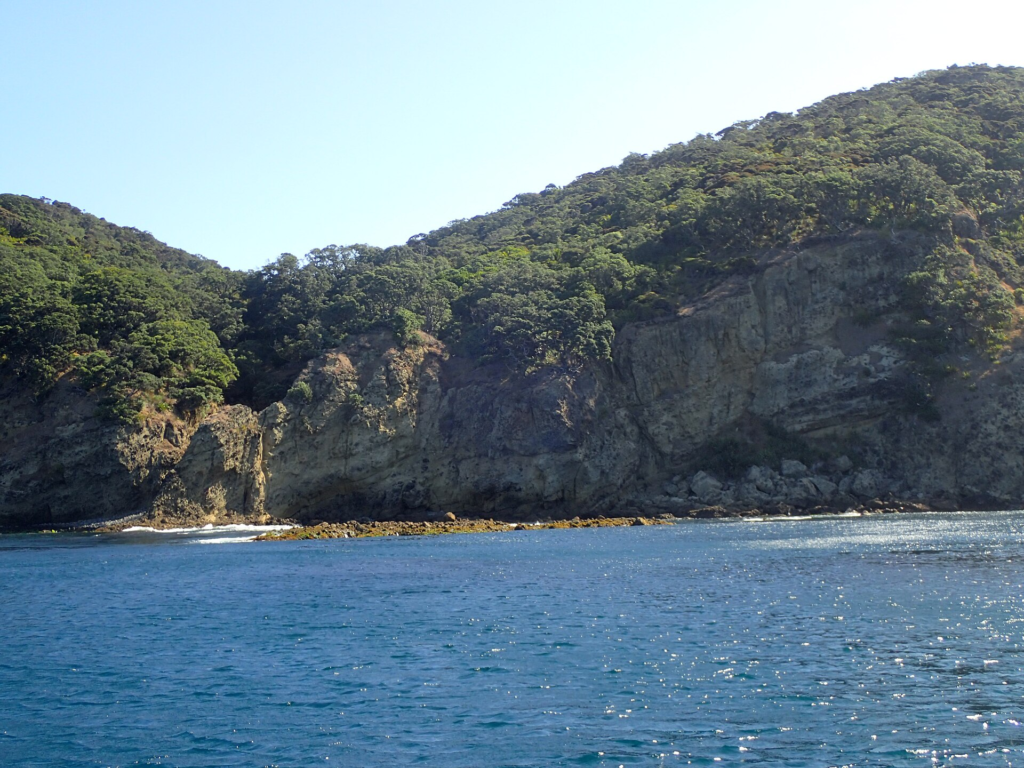
Accused on the beach
When the four men were driven to the mainland by the island’s constable and held a press conference, the case against them looked substantial. Radio transmissions logged after the capsize date had placed the Rose-Noëlle hundreds of miles from where Glennie said she had gone over. Four months in the southern Pacific, including stretches near active shipping lanes, and not a single confirmed sighting. And four survivors who, after 119 days of rationed soft drink and raw fish, had somehow found time to bathe, shave, change into fresh clothes, and work through a wine cellar before presenting themselves to the world.
The rumors spread quickly. Drug run. Fabricated story. British publishers refused Glennie’s manuscript outright, calling the account a hoax. The Minister of Transport ordered a formal inquiry.
The key witness turned out to be a barnacle.
Captain Mel Bowen of the Maritime Transport Division dove the wreck at Little Waterfall Bay himself. He recovered from the hull’s topsides a dense colonization of marine growth on surfaces that would normally never spend time underwater. A University of Auckland zoologist examined the growth and aged it at 60 to 90 days of immersion. The species was Lepas australis, a goose barnacle associated with cold southern latitudes, not typically recorded north of 39 degrees south. The hull had drifted for months, and it had drifted precisely where Glennie said it had.
A meteorologist named Greg Reeve was commissioned to model the drift against 1989 wind data. His first attempt produced a track heading east toward Chile. He thought he was being deceived. Then he realized he had pulled the wrong year’s charts. When he ran the model again with the correct data for the abnormal winter of 1989, the track looped west, doubled back, traced a figure eight in the ocean, and ended at Great Barrier Island. The official inquiry report, issued in November 1989, confirmed the story in full.
New Zealand used the embarrassment productively. The inquiry findings became the parliamentary evidence for installing a 406 MHz EPIRB ground station, the kind that would have pinpointed the Rose-Noëlle’s position within hours of the capsize and relayed it directly to rescue services. Every sailor pulled from those waters in the years since owes something to four men and an upturned boat.
The four crew members came ashore and, in the main, never spoke to one another again.
Rick Hellriegel was diagnosed with a brain tumor within two years of his return and died shortly after. Jim Nalepka had nursed him through it. Whatever the 119 days had taken from Nalepka, they had given him a vocation. He became a nurse and spent the rest of his working life doing professionally what he had done in that upturned cavity for a dying friend. Phil Hoffman went home to Karen and had a fifth child. He died in 2015, and the mourners at his funeral played Rod Stewart’s “Sailing.”
John Glennie had lost the boat, nineteen years of his own labor, a quarter of a million dollars uninsured, his handwritten log, and nearly his name. He said something at the wreck site, and a friend heard it and printed it. “She had done what I wanted. She looked after me. I never even looked back at her.”
A boat named for a woman dead sixteen years before her crew ever stepped aboard had kept every promise her builder made on her behalf. She had stayed afloat. She had fed them off her own hull. She had found the one navigable gap in a hundred miles of cliff and put four men ashore.
Then she broke up on the rocks and let them go.
