
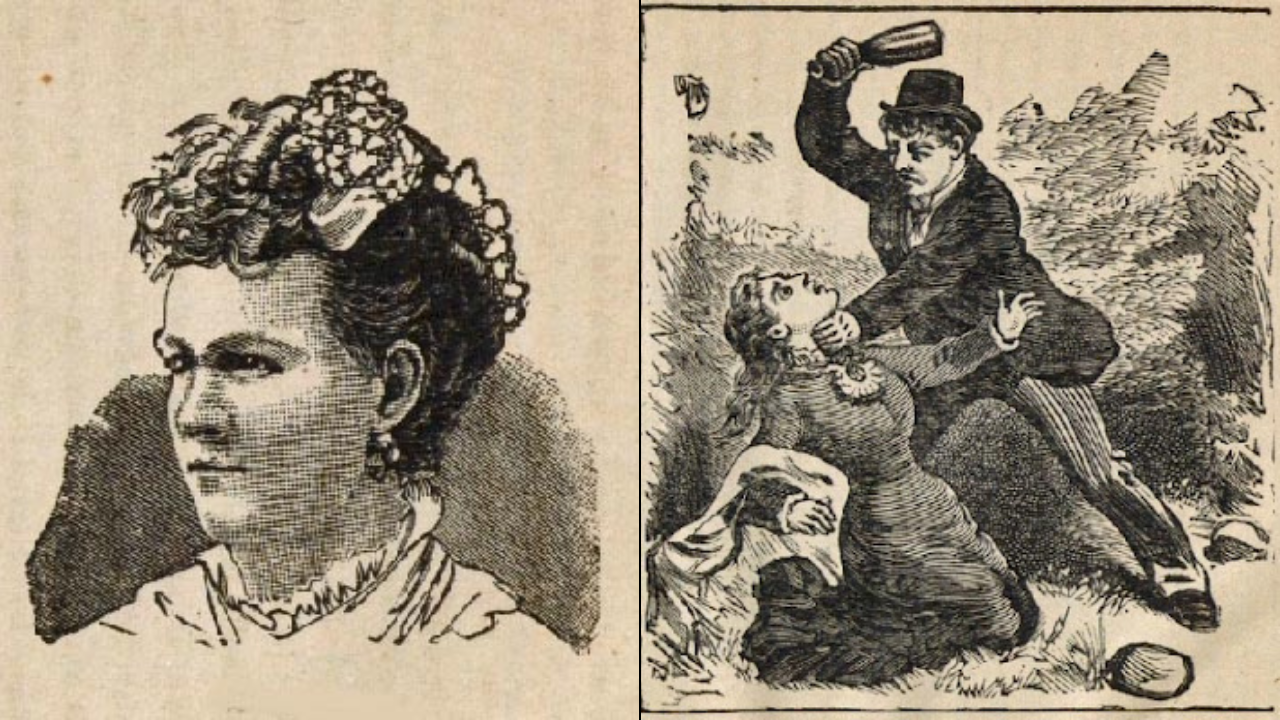
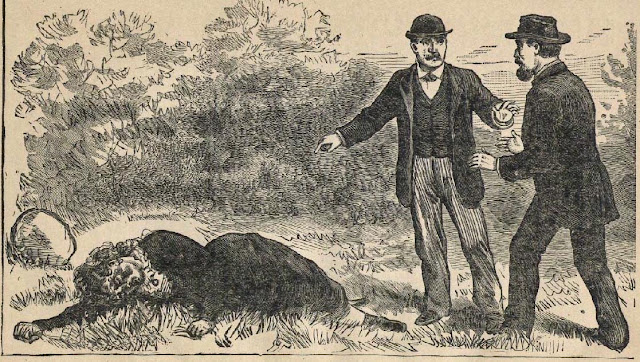
On the morning of Friday, May 13, 1881, a man gathering leaves near Guttenberg, New Jersey, felt something beneath his feet. He looked down and found a young woman lying on the grass. Someone had tried to conceal her with leaves and branches. She was dead. Her face was badly injured, her skull fractured, and an earring had been torn from her left ear.
The police cordoned off the area and the coroner of Hoboken arrived that afternoon to examine the body. She had been an attractive woman with small, symmetrical features and was estimated to be around 25 years of age. The wounds on her head had been made with the edge of a heavy stone. She lay unidentified for five days.
A Life in Two Parts
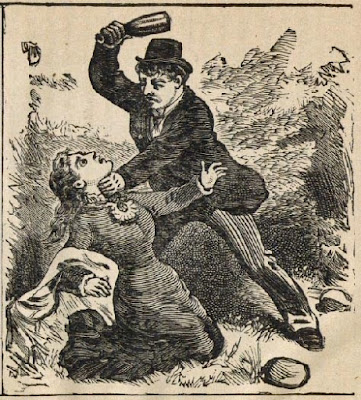
Philomena Muller, known to everyone as Mena, had been married since 1874 to Simon Muller, a tobacconist who operated a shop at 502 West 13th Street in New York City. For nearly four years the couple had lived together at 338 West 39th Street. They separated in 1878. Mena moved to an apartment nearby for a time before eventually finding work in a butcher’s shop on Third Avenue. She was 34 years old, attractive, and sociable, and she had not abandoned the idea of a better life.
In the spring of 1881, Mena’s sister Maria Schmidt told Simon Muller that Mena had found a new man. He was described as a decent, respectable gentleman from Alsace, the French-speaking region along the Rhine that had been annexed by Germany following the Franco-Prussian War and incorporated into the unified German Empire in 1871.
The man had proposed marriage and promised that they would travel to Europe together aboard the French ocean liner SS L’Amérique, scheduled to depart New York on May 4. Mena had sold her furniture and had in her possession $116, her savings, ready for the journey.
Mena’s brother had advised her against the plan. She was not yet divorced from Simon Muller. She had known this new man for only a short time. She did not listen. She registered her new address as 1247 Third Avenue, New York, and prepared to begin again.
The Wedding Day
On May 2, 1881, a man and woman checked into Scherrer’s Hotel on Christopher Street in Manhattan. They gave their names as Mr. and Mrs. Louis Kettler. On the morning of May 3, a Tuesday, the two took the Christopher Street Ferry across the Hudson River to Hoboken, New Jersey. Neither of them was legally free to marry. Both had living spouses. Neither of them appeared to care.
The ceremony was performed by Reverend Dr. Mabon at the Grove Reformed Dutch Church in Hoboken. The church register recorded the following: Louis Kettler, single, age 33, bricklayer, residence 1511 Second Avenue, New York; married to Mena Schmidt, single, age 34, residence 1247 Third Avenue, New York. Both contracting parties born in Cattenheim, Germany. Reverend Dr. Mabon could not recall much about either of them, but his servant remembered the groom more clearly: a man with a full face and a dark moustache who paced back and forth in the garden before the ceremony, his head down, as though his mind were troubled.
After the service, Mena stopped at an inn on Weaverstown Road run by a man named Edward Stabel. She wanted to celebrate. She told Stabel that she had just married for the second time, that she had previously been wed to a tobacconist, and that she would soon be sailing to France. Because Stabel did not have a bottle of Rhine wine, he sent his granddaughter to a nearby store to fetch one. While she waited, Mena talked. She talked at length. Stabel noticed a gentleman waiting outside for her but could not get a clear look at him.
The couple then visited an alehouse whose owner was Mrs. Frinck, wife of an ale house keeper. Mena drank beer while the gentleman ordered soda water. Once again, Mena talked incessantly. Mrs. Frinck noticed rolls of banknotes in Mena’s pocketbook. Before leaving, Mena borrowed a corkscrew to open the Rhine wine she had bought.
Late that night, Louis Kettler returned alone to Scherrer’s Hotel. He told the hotel’s owner, Mr. Scherrer, that Mena had decided to spend the night at her sister’s house and that they would meet the following morning aboard the steamship. The next day, May 4, Kettler checked out of the hotel and had four trunks delivered to the SS L’Amérique’s pier. He never boarded. Mena never arrived. Simon Muller had gone to the wharf that morning and watched every passenger board the ship. His wife was not among them.
The Investigation
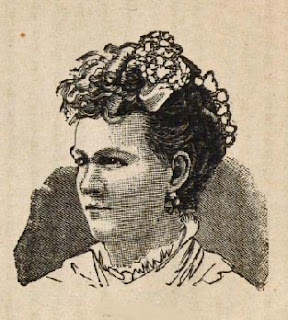
On May 18, five days after the body was found near Guttenberg, Simon Muller arrived at the mortuary accompanied by Maria Schmidt, his sister-in-law, and a police sergeant. Muller had reported his wife missing. The two were shown the body and the recovered clothing and jewellery. Maria Schmidt, overcome, did not enter the room where the body lay. Muller entered and confirmed that the deceased was indeed his wife, Mena.
He recognised both her dress and her jewellery.
The sergeant already knew that the Mullers had been separated for years. He now learned about the new man, the planned voyage to Alsace, and the bigamous marriage. Investigators believed that Louis Kettler had mrdered Mena Muller to steal her $116 and her jewellery. A telegram was sent to the port authorities at Le Havre, France, describing Kettler and requesting his detention on a charge of mrder. Two detectives were put on standby to sail for Europe.
Detectives Swinton and Fanning traced the couple’s movements through a chain of witnesses. Mrs. Frinck’s description of the woman in the alehouse matched the body found near Guttenberg. Edward Stabel at the inn on Weaverstown Road confirmed the same woman had been in his establishment celebrating a wedding. Reverend Dr. Mabon at the Grove Reformed Dutch Church confirmed he had performed the ceremony.
At the Third Avenue address listed in the church register, no one knew a Mena Schmidt, but an expressman recalled transporting four large trunks for a Mena Muller to Scherrer’s Hotel on Christopher Street. At the hotel, the story told by the widower matched in every detail.
The Reporter’s Lead
While the police were preparing to send detectives to France, a reporter for the Jersey City newspaper named Gustavus Seide was not convinced that Louis Kettler had actually sailed on the SS L’Amérique. No one had confirmed the trunks were delivered to the pier. No one had confirmed Kettler had boarded.
Seide tracked down the expressman, C.A. Strang, who told him something unexpected: he had not delivered the trunks to the French pier at all. He had been instructed to take them to a house on Charles Street. About ten days later, he had moved three of the four trunks to an address on 36th Street.
Seide visited the Charles Street address. The landlady, Mrs. Clifford, told him that a gentleman had rented a room for ten days. He paid his rent promptly, went out most nights, and spent his days reading the newspapers with what she described as great interest. One day he announced he was moving to California and left, taking three trunks with him but leaving one behind, full of crockery and cookware.
Seide and Strang loaded the abandoned trunk into a cart and took it to the 36th Street address. No one there knew a Louis Kettler, but neighbours said a man matching the description lived in a room with his wife and two children under the name Martin Kinkowski. Kinkowski was not home when they arrived. His wife, however, recognised the trunk and paid Strang fifty cents to carry it inside.
As Seide and Strang waited across the street for Kinkowski’s return, a Hoboken police constable arrested them. The police, following their own inquiries, had arrived at 36th Street looking for the same man and had mistaken Seide for Kinkowski. The situation was resolved at the police station and the two men were sent back. That evening, Martin Kinkowski walked toward the house on 36th Street and was arrested.
Before he could be safely transferred to a jail cell, a crowd of more than 400 people had gathered outside the building, calling for his death. He was moved to the Hoboken ferry, but another mob was waiting on the New Jersey side. When Kinkowski was finally secured in his cell, jailers kept him under constant watch. He was so despondent, they feared he would take his own life.
The Trial
Kinkowski denied everything. He admitted that he had known Mena Muller and that they had spent the day of May 3 together at Scheutzen Park in New Jersey He said that when they left a saloon, two men approached and one greeted Mena by name, saying: “Hello, Mena! What are you doing over here?” Kinkowski claimed that on hearing this he told her: “If you are that kind of woman, I’ll have nothing to do with you,” and walked away, leaving her with the two strangers. He said he had never seen or heard from her again. He denied that the trunks at 36th Street were his and denied that he had stayed on Charles Street under a false name.
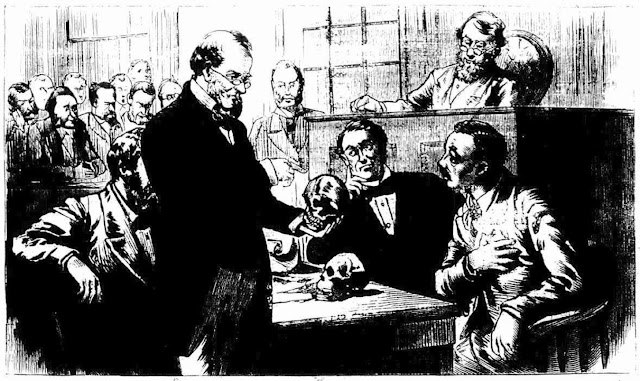
The trial of Martin Kinkowski opened on October 5, 1881, at the Hudson County Court of Oyer and Terminer, prosecuted by New Jersey Attorney General Stockton. The prosecution brought a parade of witnesses: Mrs. Frinck, who had seen the couple at the alehouse; Edward Stabel, who had sold them the wine; Reverend Dr. Mabon’s servant, who had watched the groom pace the garden before the ceremony; Mr. Scherrer, who had seen Kettler return alone that night; and C.A. Strang, who had moved the trunks. At one point the courtroom fell silent when the medical examiner produced Mena Muller’s skull before the jury to demonstrate the nature and severity of the wounds.
The entire case against Kinkowski was circumstantial. No witness had seen him strike Mena Muller. No physical evidence connected him to her wounds. His defense attempted to undermine the prosecution’s timeline and offered his own account of the two strangers as the true culprits. The judge refused his request to take the court to the actual location where he claimed to have last seen her.
During the Attorney General’s closing argument, when Stockton declared Kinkowski to be the mrderer, Kinkowski jumped to his feet and shouted that God knew he was innocent. The jury deliberated for one hour. When the foreman delivered the verdict of guilty, Martin Kinkowski fainted.
The Gallows
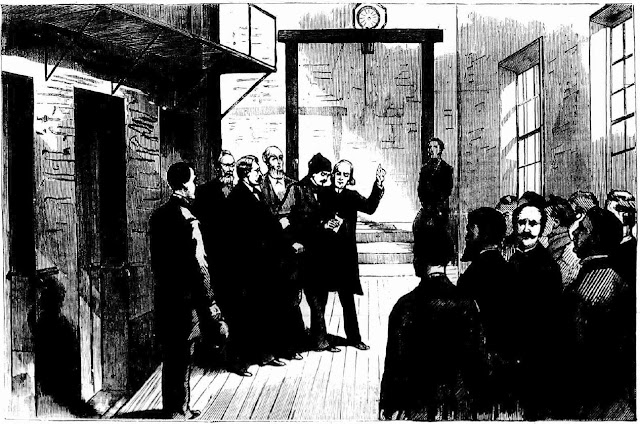
In the days that followed the verdict, Kinkowski suffered what contemporary accounts described as nervous prostration. His attorney appealed on procedural grounds and moved for a retrial. The motion was denied. At his sentencing, when asked if he had anything to say before the death penalty was pronounced, Kinkowski spoke in German. An interpreter translated his words for the court: “Since this courthouse has been built, a more innocent man than myself never stood before this Court, and God knows it.” On January 6, 1882, Martin Kinkowski was led to the gallows inside the Hudson County Jail in Jersey City. He made no confession.
He maintained his innocence until the end. Philomena Muller, 34 years old, had been buried at the Lutheran Cemetery on May 20, 1881, three weeks before the man convicted of her mrder even had a name. She had sold her furniture, saved $116, and planned to start over in Alsace. The $116 was never recovered. Neither was her jewellery. The two strangers Martin Kinkowski claimed to have seen on the road that day were never identified and never came forward.
