
Three people were shot dead in the Australian outback in December 1957. A man was convicted on a confession he said was coerced. Sixty-five years later, the case has never been formally resolved.
On the night of 5 December 1957, somewhere along the long unpaved road south of Kulgera in northern South Australia, three people made camp beside their Standard Vanguard sedan. They built a fire, brewed tea, and laid down to sleep. None of them would reach Adelaide.
The bodies of Thyra “Sally” Bowman, 43, her fourteen-year-old daughter Wendy, and family friend Thomas Whelan, 22, were found eight days later at an abandoned property known as Sundown Station. All three had been bludgeoned and shot. Their two dogs were dead nearby.
The search for whoever had done it became one of the largest manhunts in South Australian history. And the man who was eventually hanged for it may not have been responsible.
The family at Glen Helen
Pete and Sally Bowman were a well-regarded couple who had raised two daughters in Adelaide. Marion, the eldest, had contracted encephalitis at a young age, leaving her with neurological disabilities. Their younger daughter was Wendy. In 1957, Pete’s brother Brian Bowman purchased a remote pastoral station in Australia’s Northern Territory, roughly four hours west of Alice Springs. Brian also managed other properties and could not run all of them alone.
He asked Pete to bring the family north to look after Glen Helen Station. A few months later, the Bowmans made the 1,500-kilometre move from the city to the outback.
Life at Glen Helen proved harder than expected.
The property was isolated and had been through drought. In November 1957, a 22-year-old named Thomas Whelan, who had previously worked alongside Pete in Adelaide, traveled north to visit.He agreed to stay three weeks and then travel back with the family for the Christmas break.
The road south
On 4 December 1957, the family arrived in Alice Springs after driving in from Glen Helen. There, they split up. Because of Marion’s condition, Pete and Marion flew directly to Adelaide. Sally, Wendy, and Thomas Whelan set off by road in the family Vanguard, two dogs in the car and around 85 pounds in cash. They were last seen at Kulgera Homestead near the South Australian border, where they stopped for petrol.
They continued south. They never arrived.Pete reached Adelaide with Marion and waited. By Saturday 7 December he had prepared a meal expecting the rest of the family home that evening. They did not come. The following afternoon he contacted police.
The Royal Flying Doctor Service searched by air. Ground parties went out along the route. Travelers heading south were stopped and questioned. Nobody had seen a woman, a young man, and a teenage girl in a Vanguard. By 10 December, the story had reached front pages across the country.
The discovery at Sundown Station
On 13 December 1957, a Royal Australian Air Force pilot spotted the Vanguard partly concealed in scrub at the deserted Sundown Station. When police reached the car, they found it empty. There was a pool of blood in the back seat and smears on the inside of a door. A section near the driver’s seat appeared to have been wiped down in a hurry.
Near the vehicle were two sets of footprints. One, matching a women’s shoe around Australian size four, led from the car to the main road. A second, made by a man’s shoe estimated at size seven or eight, ran from the road to the car and back, and also led from the front of the car toward scrubland. Officers followed those tracks for around 600 metres until they came to a mound covered with a green tarpaulin next to a tree.
Underneath were three decomposing bodies and bloodied blankets. They were Sally Bowman, Wendy Bowman, and Thomas Whelan. The Bowman dogs were found shot nearby. Drag marks in the earth connected the campfire to the mound. Tracks from another vehicle, apparently towing a trailer, headed north toward Alice Springs.
Post-mortems established that all three victims had been alive when struck on the head with the butt of a rifle. Thomas Whelan had been shot three times from behind and bore fracture wounds to his forehead and face. Sally Bowman was shot once in the back of the neck and had fractures to the right side of her head.
Wendy Bowman had been struck twice on the left side of her head and had also been shot. The blood pooled at the campfire matched the head wounds. The rifle used to shoot them was not the Bowmans’ own .22 Remington, which was recovered at the scene. It was a second weapon. That weapon was never found.
Bailey was arrested in Mount Isa
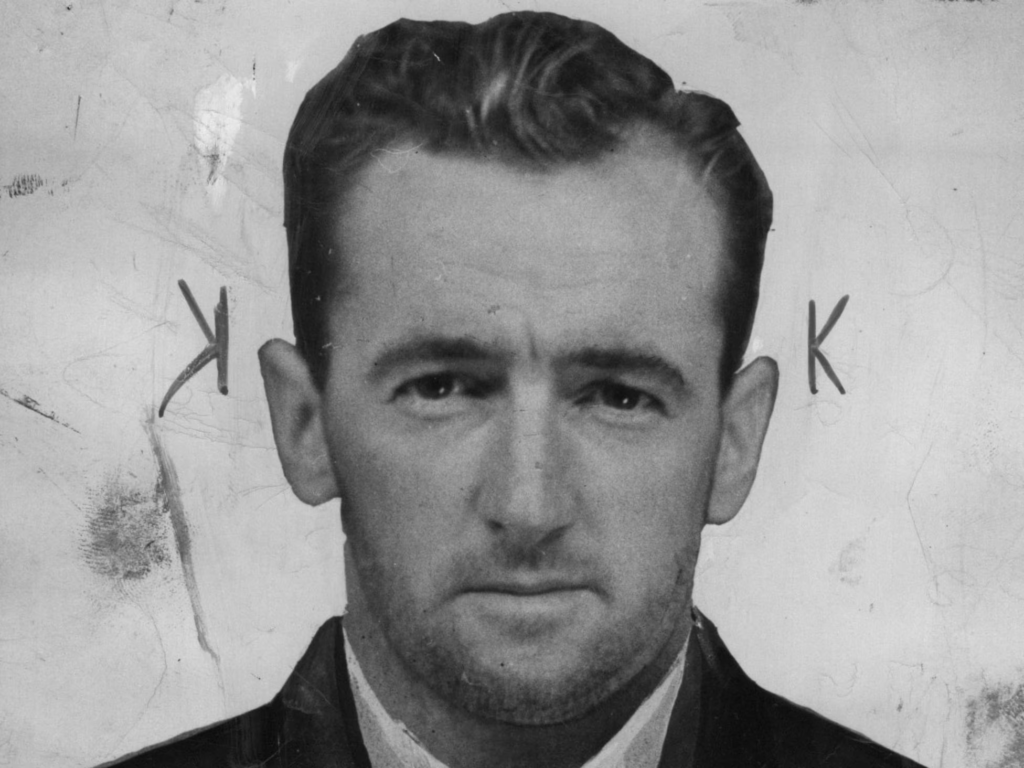
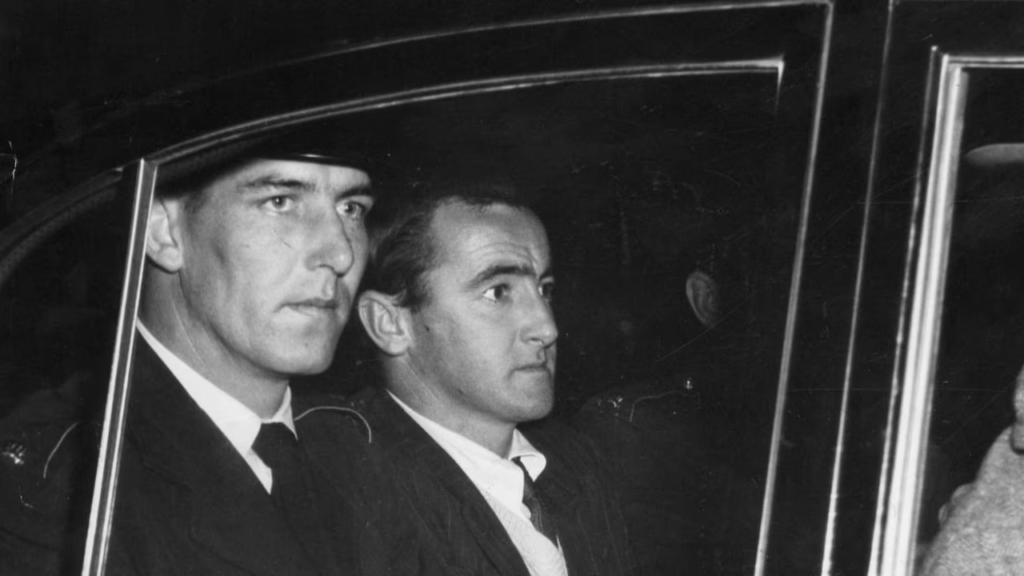
On 21 January 1958, police in Mount Isa, Queensland, pulled over a man driving a black 1938 DeSoto with South Australian plates. He was carrying an unlicensed firearm. The man was Raymond John Bailey, born 3 December 1932 in Gilgandra, New South Wales.
He had four brothers and a sister, had left school at fourteen to train as a carpenter, married young, and had spent years moving from job to job. In September 1957, he had obtained the DeSoto in Renmark without paying for it and set off north with his wife and young son, towing a trailer, in search of work.
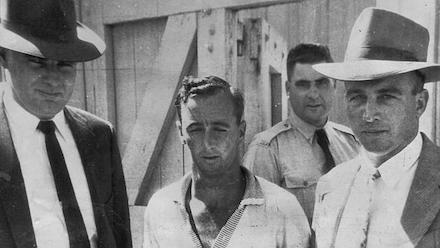
At the Mount Isa police station, a detective named Glen Patrick Hallahan questioned Bailey at length. Hallahan focused not just on the firearm charge but on Bailey’s whereabouts on the night of 5 December 1957. Bailey said he had been traveling through the area, had briefly stopped to speak with a woman in a camp alongside a young man and a girl, been invited to join them for dinner, declined, driven a short distance up the road, and parked for the night.
After days of questioning, Bailey gave a statement treated as a confession. In it, he described going for a night walk with his rifle, coming upon the sleeping camp, being startled by one of the dogs, and firing. He said the confrontation escalated and he shot all three victims to prevent them from reporting him to police.
He said he moved one of the bodies to the Vanguard, drove it into the scrub, and later returned to shoot the dogs and cover everything with tarpaulin. He claimed to have taken 25 pounds from Thomas Whelan, which he later threw away. Bailey was charged with triple murder and extradited to Adelaide.
The trial and the verdict
The trial began in Adelaide on 12 May 1958. A witness named David Iles told the court that he had worked alongside Bailey near Wirrulla, South Australia, in September 1957. The two men had gone rabbit shooting together. Iles had agreed to sell Bailey a Sportco Huntsman single-shot bolt-action .22 rifle, but Bailey had left without paying for it. Ballistics experts found that cartridge cases from the murder scene matched cases recovered from where Iles and Bailey had fired rabbits together.
The prosecution’s case, outlined by Crown counsel Scarfe, was that Bailey had pulled up alongside the Bowman camp and that a confrontation had escalated into a triple killing, likely originating from an attempted robbery. The defence countered that the case was entirely circumstantial.
The murder weapon had never been found. Bailey claimed he had sold the Huntsman rifle to a man near Coober Pedy before the murders. Witnesses described the car seen near the crime scene as a grey Ford Zephyr, while Bailey drove a black DeSoto. Female footprints at the scene suggested a woman had moved the Vanguard, but Bailey’s wife could not drive. And the male shoe size at the scene, estimated at seven or eight, did not match Bailey’s actual size of five and a half.
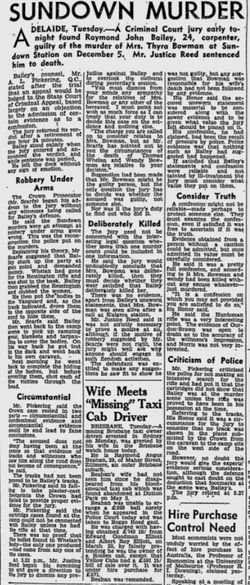
Bailey told the court he had signed the confession only after hearing his wife crying in an adjacent room, and after being told by detectives that they would stop questioning her if he signed. The defence argued that where the circumstantial evidence failed to close into a complete circle, the accused was entitled to the benefit of the doubt. The jury took 96 minutes to return a guilty verdict. Bailey was sentenced to death.
His appeal was dismissed. Bailey then claimed that on the night of the murders he had confronted another man at the scene, killed him in a fight, and buried the body four miles north of where the victims were found. The state cabinet authorised a search. Bailey was flown to Alice Springs and driven to Sundown Station with a fourteen-man team of police trackers, lawyers, and prison officers.
After three and a half hours, no body was found. Bailey said, “I have nothing more to say.” He was hanged at Adelaide Gaol on 24 June 1958. He was 25 years old.
Doubts that outlived the verdict
In November 2012, investigative journalist Steve Bishop published The Most Dangerous Detective: The Outrageous Glen Patrick Hallahan. The book argued that Hallahan had fabricated Bailey’s confession and lied under oath at trial.
Bishop drew on more than two decades of research, including interviews with political leaders, senior police, and barristers.
Hallahan’s wider record made the challenge difficult to dismiss. He was later identified as one of three senior Queensland detectives, alongside Tony Murphy and Terry Lewis, collectively known as the “Rat Pack,” who were exposed as corrupt during the Fitzgerald Inquiry in the late 1980s.
The inquiry found Hallahan had given fraudulent evidence to secure a conviction in an unrelated 1963 case. Bishop argued the same pattern had played out in 1958.
The evidentiary problems Bishop identified were specific and documented. Bailey’s confession said Sally Bowman was shot as she rushed toward him. The post-mortem established she had been shot in the back of the neck while face down on the ground. His statement described all three victims being shot at the campfire.
The autopsies placed the shootings where the bodies were found, not at the fire. Hallahan testified at trial that Bailey’s wife was never questioned. Bailey said he could hear her being questioned in the next room. The murder weapon was never found. And the footprints at the scene belonged to someone whose shoe size was larger than Bailey’s by two full sizes.
In February 2013, Bishop formally appealed to the Governor of South Australia, Kevin Scarce, for a posthumous pardon for Bailey. The appeal was declined. Petitions on Bailey’s behalf continued to be filed in subsequent years. Glen Patrick Hallahan died in 2016.
What happened near Sundown Station on the night of 5 December 1957 has never been established beyond dispute.
Sally Bowman was 43 years old. Wendy Bowman was fourteen. Thomas Whelan was 22 and a long way from home. Whoever killed them has not been definitively identified. Raymond John Bailey went to the gallows without that question being settled. It remains unsettled still.
