
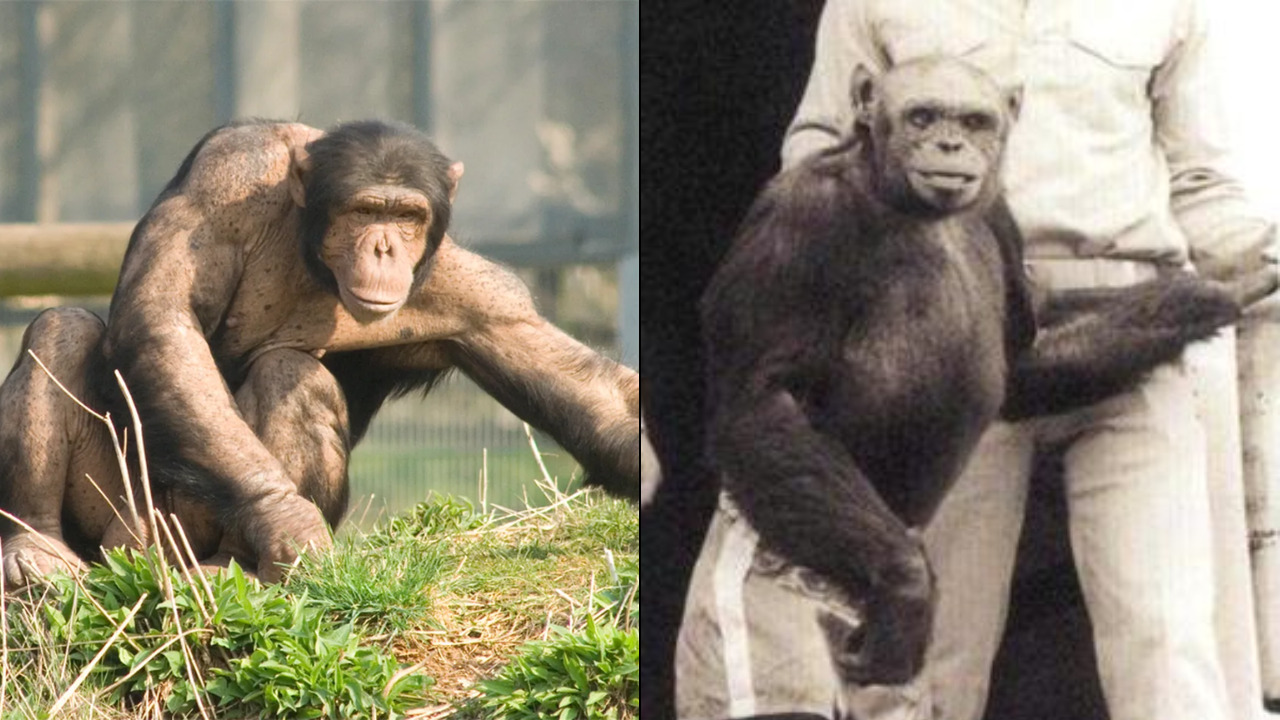
In November 1926, a 56-year-old Soviet biologist named Ilya Ivanovich Ivanov arrived at the botanical gardens of Conakry, in the French colony of Guinea, accompanied by his son and a supply of human semen. He had spent years lobbying Soviet authorities for funding. He had traveled thousands of miles from Moscow. He had the backing of the Soviet Academy of Sciences, and, reportedly, of Joseph Stalin himself.What Ivanov planned to do next had never been attempted in recorded history.
A weapon dressed as science
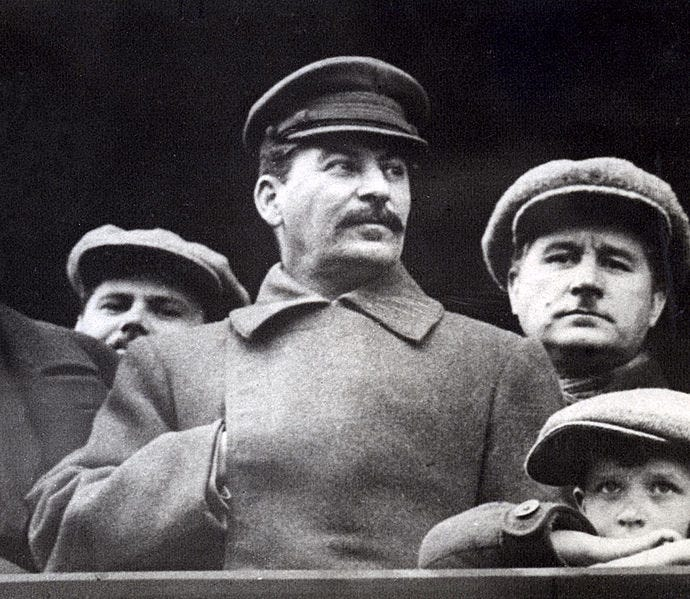
By the mid-1920s, the Soviet Union was in crisis. The devastating losses of the Russo-Japanese War and the First World War had crippled Russia’s military capacity, and Lenin’s Red Army had emerged from the Civil War badly depleted. When Lenin died in 1924, his successor, Joseph Stalin, inherited a nation under intense pressure to industrialise and rebuild its defences. He needed a labor force. He needed soldiers. He needed bodies that would not complain.
According to reports first published in The Scotsman in 2005, Stalin is said to have communicated to his Academy of Sciences a vision for what that force might look like: a new type of soldier, invincible and insensitive to pain, indifferent to hunger and the quality of food. Whether that specific directive came from Stalin himself remains disputed. What is not disputed is that a proposal for human-ape hybridisation arrived at the Academy at exactly the moment it would find the most receptive audience.
The Soviet state under Lenin and then Stalin was aggressively and systematically anti-religious. The Bolsheviks had moved to dismantle the Russian Orthodox Church, close monasteries, and arrest clergy. Religion was not merely tolerated as irrelevant. It was treated as a direct threat to communist authority. Into this climate, Ivanov brought his proposal, and he framed it with precision. According to Cambridge historian Alexander Etkind, who analysed the available archival evidence, Ivanov pitched the experiment to Soviet authorities not primarily as military research but as a way to prove Darwin right.
If a viable human-ape hybrid could be produced, it would demonstrate the evolutionary closeness of humans and great apes. It would, in Ivanov’s framing, strike a decisive blow against religion. The Bolsheviks, who hated everything the Church represented, loved it.
In September 1925, the Soviet Financial Commission approved $10,000 for the project, processed through Nikolai Petrovich Gorbunov, a one-time personal secretary to Lenin who had become head of the Department of Scientific Institutions. Gorbunov would remain Ivanov’s primary patron inside the Soviet apparatus for the next several years. The Academy of Sciences formally approved the proposal. Ivan Pavlov, already the world’s most famous physiologist and a distinguished Academy member, was present in the room when the decision was made.
The biologist who made the pitch
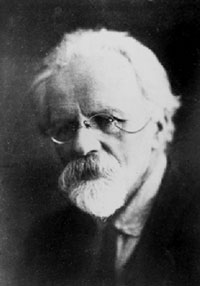
Ilya Ivanovich Ivanov was born on August 1, 1870, in Shchigry, a town in Russia’s Kursk region. He graduated from Kharkiv University in 1896 and later completed postgraduate coursework at the Pasteur Institute in Paris. By the early 1900s, he had become the world’s leading authority on artificial insemination, developing techniques that allowed a single stallion to fertilise up to 500 mares, compared to the 20 or 30 possible through natural means.
Breeders traveled from across Europe to work with him. His interspecific hybridisation work produced a zedonk, a cross between a zebra and a donkey, along with crosses between bison and cattle, mice and rats, and guinea pigs and rabbits.As early as 1910, he had delivered a paper to the World Congress of Zoologists in Graz, Austria, laying out his hypothesis: that because humans and great apes were so closely related biologically, a hybrid might be achievable through artificial insemination.
One scientific predecessor he cited was the German researcher Hans Friedenthal, whose 1900 blood cell analysis between humans, chimpanzees, gorillas, and orangutans had shown far greater serological similarity than most scientists had assumed, leading Friedenthal to propose that anthropoid reproductive cells might be close enough to produce a hybrid.The idea sat dormant for over a decade. Then the Soviet state gave Ivanov both the money and the motive to test it.
Two failures in Africa
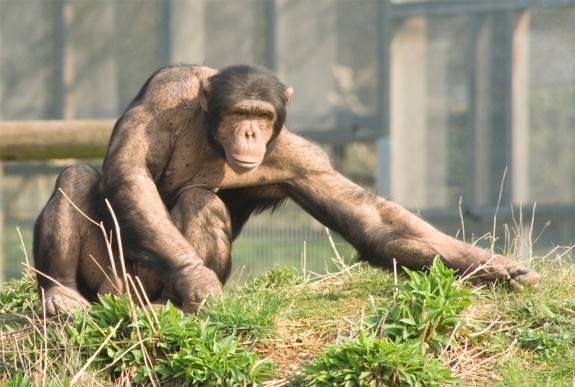
In March 1926, Ivanov arrived at the Pasteur Institute’s primate facility in Kindia, French Guinea. What he found there killed the experiment before it could begin. Every chimpanzee at the station was a juvenile. None had reached sexual maturity. There was nothing to work with.Ivanov stayed approximately one month. He then arranged, through correspondence with the colonial governor of French Guinea, permission to use the botanical gardens in Conakry as an alternative site. He returned to France, regrouped, and headed back south.
By November 1926, Ivanov and his son were in Conakry. Local hunters captured thirteen adult chimpanzees from the interior of the colony, which were brought to the gardens and held in cages. On February 28, 1927, Ivanov artificially inseminated two female chimpanzees with human sperm. On June 25, he inseminated a third.
While at Conakry, Ivanov attempted to expand the experiment in a direction that no colonial authority would sanction. He approached doctors at a local hospital about secretly inseminating African women with chimpanzee sperm, without informing the women of what was being done. The colonial governor of French Guinea rejected the plan. When word of the proposal reached the Soviet Academy of Sciences back in Moscow, it further damaged Ivanov’s standing among colleagues who had already grown uneasy about the direction of his work.
Ivanov and his son left Africa in July 1927 with thirteen chimpanzees, including the three used in the insemination attempts. Before they left, it was already clear the first two females had failed to conceive. The third died in France and was found not to have been pregnant. All three inseminations had failed.The ten surviving chimpanzees were shipped to a new Soviet primate research facility at Sukhumi, in the Georgian region of Abkhazia. The facility had been established partly to support exactly this kind of work. Sukhumi was also, not incidentally, the region of Stalin’s birth.
The reverse experiment
Back in the Soviet Union, Ivanov did not abandon the project. He proposed what he called the “reverse experiment”: inseminating human women with chimpanzee sperm. The logic, in strictly biological terms, was symmetrical. If the hybrid was possible, it should work in either direction.By 1929, with Gorbunov’s continued support, Ivanov secured backing from the Society of Materialist Biologists, a group affiliated with the Communist Academy.
A commission was established in the spring of 1929 to plan the Sukhumi experiments. It determined that at least five female volunteers would be needed. The women, according to accounts later gathered by researchers at the Sukhumi Institute, were recruited from among local prisoners. How voluntary the participation of inmates in a Soviet laboratory in 1929 truly was is a question the historical record does not resolve cleanly.
In June 1929, before a single insemination had taken place, Ivanov received news that destroyed the experiment. The only sexually mature male ape at the Sukhumi facility, an orangutan, had died. There were no viable subjects. A new batch of chimpanzees was ordered and eventually arrived in the summer of 1930.By then, it was too late for Ivanov.
What the experiment almost certainly could not have produced, regardless of logistics, was a hybrid. Humans carry 46 chromosomes. Chimpanzees carry 48. Even in the event of fertilisation, the chromosomal mismatch would make viable offspring biologically implausible. Ivanov either did not know this or chose not to accept it. The science he was pursuing was, in every practical sense, chasing an impossibility.
Arrest and exile
In the spring of 1930, Ivanov’s veterinary institute came under political criticism as Stalin’s purge of Soviet scientific institutions accelerated. Researchers across disciplines were being swept up on charges of ideological disloyalty. On December 13, 1930, Ivanov was arrested by the secret police and accused of belonging to a counter-revolutionary organisation. The costly, years-long experimental failures gave his accusers convenient ammunition.
He was sentenced to five years of exile in Alma-Ata, in the Kazakh Soviet Republic, where he was assigned to work at the local veterinary and zoological institute. He never completed the sentence. On March 20, 1932, Ilya Ivanovich Ivanov died of a stroke. He was 61.Ivan Pavlov, the Nobel laureate, wrote his obituary.
The following year, composer Dmitri Shostakovich began sketching a satirical opera, with a libretto by Aleksey Tolstoy, about a Soviet scientist who creates a half-human, half-ape creature. The opera, titled Orango, was left unfinished. The prologue survived.
The chimp who confused the world
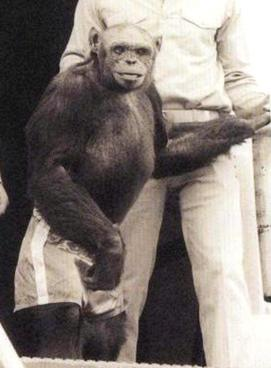
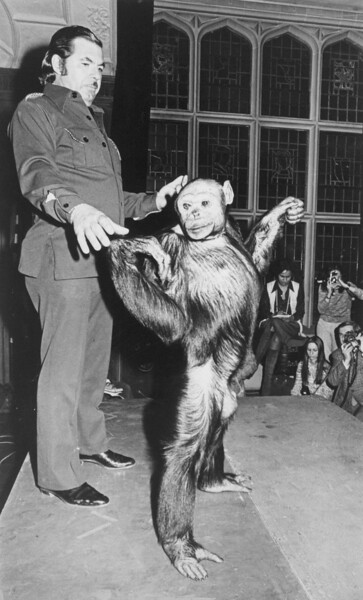
Years later, an animal bought in 1970 by American trainers Frank and Janet Berger would briefly reopen every question Ivanov had died trying to answer. Oliver, a chimpanzee allegedly captured in the Democratic Republic of the Congo, walked upright more consistently than any chimp his handlers had encountered. His face was unusually flat. He was bald in a way that suggested age rather than species.
He appeared, at times, to prefer the company of human females to that of other chimpanzees. When he reached the age of 16, Janet Berger later said, his attraction toward her became impossible to ignore. They sold him.
Oliver passed through the hands of a New York lawyer, appeared on Japanese television, and spent years featured in freak shows billed as a missing link between humans and apes. Promoters claimed he had 47 chromosomes, one fewer than a typical chimpanzee and one more than a human, which would have placed him precisely in the biological gap Ivanov had been trying to fill.
Scientific institutions eventually spent years keeping him for research. By the time he arrived at the Primarily Primates sanctuary in San Antonio, Texas, in the late 1990s, he was arthritic, partially blind, and had lived through decades of exploitation.
In 1996, a geneticist from the University of Chicago tested Oliver’s DNA. He had 48 chromosomes. Exactly the number of a common chimpanzee. The earlier claim of 47 was disproved. Further analysis confirmed that his cranial morphology, ear shape, freckles, and pattern baldness all fell within the natural range of variation found in common chimpanzees from central Africa, a region that had sent very few animals to Western zoos or laboratories.
Oliver died in his sleep on June 2, 2012, at the Primarily Primates sanctuary. He was at least 55 years old. His companion, a female chimpanzee named Raisin, was found beside him.He was, in the end, just a chimpanzee. But for decades he carried the weight of a question that a Soviet biologist, funded by a dictator’s ideological war against God, had first tried to answer in a cage in Conakry. The question was never answered. The attempt, documented in pale manila folders still held at the Sukhumi Institute, is all that remains.
